
Bosque Garage Door connects homeowners across the Albuquerque, New Mexico metro with a local garage door company for garage door spring repair in Albuquerque and the surrounding towns. If you are reading this with a door that will not go up, call (505) 448-3665 and describe what happened. The call connects you with an independent local garage door company, and that company, not this site, is the one to ask about sending a technician and about the price once the door has been looked at.
Most people arrive here after the same small event. There was a sharp crack from the garage, or nobody heard anything and the door simply stopped working. The opener hums, the door lifts a few inches or not at all, and the remote seems useless. A broken spring is the most common cause of that picture. This page walks through how to confirm it, what to do in the first few minutes, how the two spring systems differ, what a replacement visit involves, and what changes the price. Read it before you call, and keep it open while the technician works if you want to follow along.
The first ten minutes: what helps and what hurts
A broken spring is not an emergency in the way a gas smell is. A closed door with a broken spring tends to stay closed. What you want to avoid is making it worse, or getting hurt trying to be helpful.
- Stop pressing the remote and the wall button. An opener is meant to steer a door that is already balanced, and it cannot lift dead weight. Each extra push wears the gear, the trolley and the top panel.
- Keep family, pets and cars away from the door, most of all when it stalled halfway open.
- Leave the springs, the cables and the brackets at the bottom corners alone. They can hold energy even when nothing is moving.
- Do not pull the red emergency release cord if the door is open or partly open. Once the opener lets go, a door that has lost its counterbalance can drop fast.
- If the door is fully closed and a car is inside, pull the release cord only with the door shut, and understand the door will then be very heavy. Lifting it by hand is a two-person job, and not a safe one.
- Take a photo of the springs and any parts on the floor. It helps the technician bring the right parts.
If something urgent depends on the door, such as a car you need this morning, the garage is open to the street, or the door is stuck halfway, say that when you call so the local company can plan around it. The emergency garage door repair page covers those situations in more detail.
Is it really the spring?
A door can fail in several ways that look alike from the driver's seat. A few quick observations sort most of them without touching anything under tension.
The sound. A single loud bang, followed by a door that will not lift, points strongly at a spring. A grinding or squealing noise during normal travel suggests dry rollers or hinges instead. A rapid clicking with no movement can be an opener gear or a power problem.
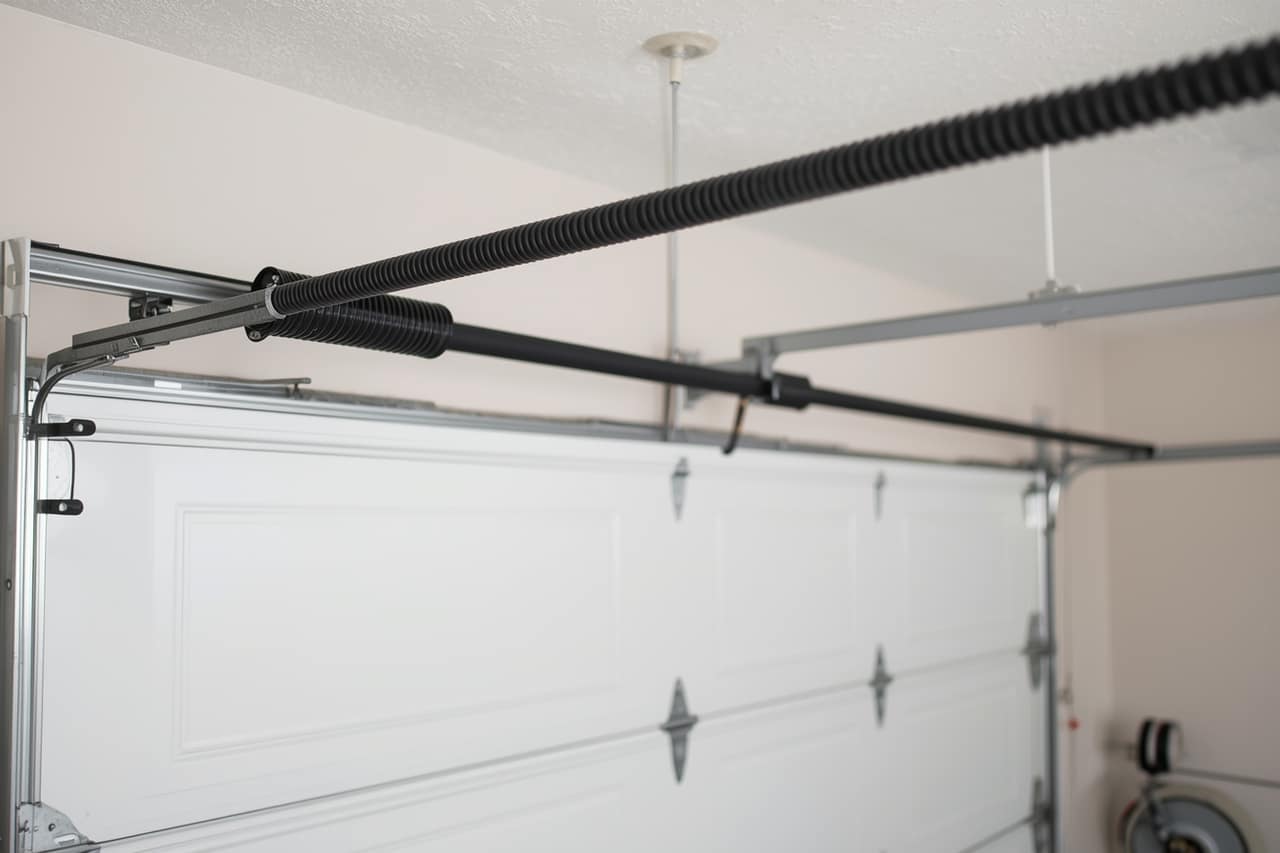
The gap. With the door closed and the power off, look at the torsion springs above the door. A spring that has broken often shows a visible gap in one coil, usually an inch or two wide. On a door with two springs, one will look whole and the other will look split.
The slack. When a spring is gone, the lift cables on each side often hang loose or sag, because nothing is pulling against them. If you see slack cable and the door is shut, the spring is the likely cause.
The weight. A balanced door feels light when you lift it a few inches with the opener disconnected. A door with a broken spring feels as heavy as it really is. That weight test is useful, but it is not worth doing alone, because a heavy door can slip. If you are not sure, skip it.
The opener. If the motor does not run at all, no light comes on, or the remote has no effect and the wall button is dead too, the problem is probably electrical, and the opener repair page is the better starting point. If the motor runs but the door hardly moves, the spring is the better suspect.
The cable and track. A door that is crooked, jammed on one side, or sitting out of the track has a different failure. The off-track repair and cable, roller and panel repair pages cover those.
None of these checks is a diagnosis. They only help you describe the problem on the phone, which makes the visit shorter.
How your door is counterbalanced
A garage door panel set is heavy. A typical two-car steel door can weigh well over a hundred pounds, and an insulated or wood-look door can weigh a good deal more. Nobody could lift that with one hand. Springs make the lifting possible by storing energy as the door comes down and returning it as the door goes up. A well-balanced door nearly hovers at the halfway point, and the opener only has to guide it.
There are two common systems, and the one you have shapes both the failure and the repair.
Torsion springs sit on a steel shaft above the door opening, one or two of them. Cables run from drums at the ends of the shaft down to brackets at the bottom corners of the door. As the door goes down, the springs wind tighter. As it goes up, they release and turn the drums. Torsion systems are standard on most newer homes and on many replacement doors. When one breaks, the door usually stops dead, because the entire counterbalance depends on it.
Extension springs run along the horizontal tracks on each side of the door, stretching as the door lowers and contracting as it rises. They are common on older homes and lighter doors. When one breaks, that side usually sags below the other, since each side carries its own spring. A broken extension spring can also whip around the garage. Extension systems should have a safety cable running through each spring to contain it. If you can see a cable running through the middle of the coil, that is what it is for. If you cannot, mention it to the technician.
Some older doors have neither. If your door uses a different arrangement, such as a one-piece tilt-up door common on older detached garages, tell the company when you call.
What wears a spring out
A spring does not fail because it is old in the way milk spoils. It fails because it has been compressed and released a fixed number of times, and each cycle is a small amount of metal fatigue. A single cycle means the door goes up once and comes down once. Springs come with a cycle rating, and the common base rating is around ten thousand cycles.
Do the arithmetic for your own household. If the garage is the front door of the house, each family member may use it twice a day, and a family of four can reach eight or more cycles daily. At that pace, a ten thousand cycle spring lasts around three to four years. A garage used only for storage, with two or three cycles a day, might go a decade.
Other factors add to cycle wear:
- Friction. Dry, dusty hinges and rollers make the spring work harder every trip. Lubrication matters more than most people expect.
- Rust. Moisture on bare steel starts corrosion that creates stress points. A spring with a rusty, flaking coil is nearing the end whatever the cycle count says.
- Imbalance. A spring that is the wrong size, or wound to the wrong tension, runs harder than it should. A door that drifts up or down when you stop it halfway is out of balance, and the springs are doing the wrong amount of work.
- Heavy upgrades. Adding insulation, windows or a heavier panel changes the weight. If the springs were never changed, they are working outside their design.
- Age of the metal. Even if the cycle count is low, a spring that has lived for fifteen or twenty years in a hot, dry garage is a candidate for failure.
High desert conditions and your springs
Albuquerque sits at roughly 5,000 feet, and the metro climbs to about 6,700 feet out toward Edgewood. Springs do not care about altitude, but the climate around them does the slow damage.
Spring is the windiest season here, according to the National Weather Service in Albuquerque, with April and May the peak. Wind pushes dust through the gaps around a door, and that dust ends up in hinges, rollers and on the coils. Dust mixes with old grease into a gritty paste that adds friction to every cycle. The result is a spring that works harder than its rating assumes.
The temperature swing matters too. The Albuquerque Sunport averages a daily range of about 25 degrees Fahrenheit, with a July average high near 91 and a January average low near 26. A garage that goes from freezing at dawn to warm by afternoon expands and contracts the metal, thins and thickens lubricant, and puts a little extra strain on springs that are already near the end of their cycle count. Stiff grease on a cold morning makes the door work harder, which is a good reason to lubricate before winter.
Strong high-desert sun fades and dries rubber seals and plastic parts, but it matters less for a spring than for the weatherstrip and opener housings. Dry air means rust is slower than in a humid city. It does not stop it, and a garage that gets water from a roof leak, a swamp cooler or a washer still corrodes steel. If you can see orange on the coils, treat the spring as near the end.
A practical routine suits this climate: wipe the track and hinges, lubricate the springs, hinges and rollers every six months or so with a lubricant made for garage doors, and do it before spring wind season rather than after. The high desert wind and dust guide goes through the full maintenance list.
What a spring replacement involves
Replacing a spring is a short job for someone who does it regularly and a hazardous one for someone who does not. Knowing the steps lets you see whether the work is being done properly.
- Securing the door. The technician closes the door, clamps the track so it cannot rise, and releases any remaining tension in the old spring safely, using winding bars sized for the job. This is the step to leave to a professional. A slipped bar can cause serious injuries.
- Measuring the door. The weight of the door, its height and the track radius determine the spring. The wire size, inside diameter and length all matter, and so does the winding direction. A matching pair on a torsion system uses one left-wound and one right-wound spring.
- Replacing the springs and, usually, the cables. With a torsion system, the old springs come off the shaft. New springs go on, the end cones are secured with set screws, and the cables are checked for fraying. Cables that have been under tension for years are often replaced at the same visit.
- Winding. A standard door of seven feet typically takes about seven and a half full turns of the spring, though the exact count depends on the spring and door. The technician marks the spring, winds it in quarter turns, and tightens the set screws.
- Checking balance. With the opener disconnected, a balanced door should stay put at about waist height and move with a light push. If it falls or rises, the tension gets adjusted.
- Lubricating and testing. Hinges, rollers and the springs get a suitable lubricant. The opener goes back on and gets a full test, including the auto-reverse and the safety sensors.
The technician should explain the cause of the failure, not just fix the symptom. If the springs broke because of a bent shaft, worn bearings or a door out of alignment, ignoring it makes a repeat visit likely.
Choices that change the spring you get
A garage door spring is not a commodity part. The choices below are worth a quick question or two before you approve the work.
Standard or high-cycle. A standard spring is built for roughly ten thousand cycles. A high-cycle spring may be rated for twenty-five thousand or more, using a different coil design. For a household that uses the garage as its main entrance, the higher rating often pays for itself in fewer visits. Not every door can take one, so ask whether the shaft, drums and track radius allow it.
Oil-tempered or galvanized. Oil-tempered springs are common and usually priced lower, but they can rust. A galvanized or coated spring resists corrosion better but is a different material treatment and is usually priced higher. In a dry climate rust is slower, but garages that see occasional water, humidity from a swamp cooler, or road salt tracked in from a car can still corrode springs.
One spring or two. A wide or heavy door is often built with two springs so each carries half the load. If one breaks, the other is the same age and has the same cycles, so replacing both in one visit is the usual practice. Two matching new springs keep the balance even and spare you a second visit in a few months.
Rebuilding the whole assembly. If the cables, drums, bearings and end brackets are worn, replacing them at the same time costs less than a second trip.
Lifting hardware and track. If the door has been running out of balance for a while, the track and hinges may be worn. Ask the technician to point out any wear before you decide.
What moves the price
Prices vary by door, spring type and who does the work, so treat the following as general national ranges, not Albuquerque quotes. Published cost guides in 2026 put a single torsion spring replacement at roughly $150 to $350 and a matched pair at roughly $200 to $450 (Fixr), while another guide puts an installed torsion spring at $350 to $540 (This Old House). Extension springs run lower, roughly $120 to $200 for one and $150 to $350 for a pair. The guides disagree with each other, and some older ones list lower figures, which tells you how much depends on the door and the parts. A local company gives the real price after looking at the door.
These are the usual things that move a spring quote:
- Torsion or extension. Torsion springs, the shaft and the cones cost more than extension springs and safety cables.
- One spring or a pair. Replacing both is the usual advice, and it usually costs less than two separate visits.
- Cycle rating. A high-cycle spring costs more up front and lasts longer for a busy household.
- Door weight and size. A heavy double door needs a heavier spring than a light single door.
- Extras found on the visit. Frayed cables, worn drums, a cracked end bearing or a bent shaft add parts and time.
- Time of day. Calls outside normal hours often cost more. National guides describe after-hours work as running 50 to 100 percent above daytime rates, so ask before you schedule.
Ask for the price in writing, with the parts listed, before the work starts. If the number sounds far above or below those national ranges, ask what is different about your door. The repair cost guide explains how to read a quote.
When the door is the problem, not the spring
A new spring on a tired door buys little. If panels are cracked, sections are delaminating, the track is bent or the door is badly out of square, you may be paying for the spring and then paying again for something else in a few months. A fair company will tell you when a spring job is not a sensible use of your money. Signs that a larger decision is on the table:
- The door is more than twenty years old and parts are hard to match.
- Several panels are dented or cracked, or the bottom section is rusted through.
- The door has been repaired multiple times in the last few years.
- You want better insulation, quieter operation or a different look.
If any of those fit, compare the cost of the spring repair with a new door. The garage door installation page explains how replacement works, and the repair cost guide explains how repair and replacement costs relate.
Questions to ask before you say yes
You do not need to be a technician to run a good conversation. A few plain questions protect you.
- Are you replacing one spring or both, and why?
- Are the cables, drums and bearings being replaced or only inspected?
- How many cycles is the new spring rated for, and can my door take a longer-life spring?
- Will the door be balanced and the opener retested before you leave?
- What does the quote include, and is anything extra if you find additional wear?
- Is anything about the parts or labor covered in writing? Ask what is covered and for how long, and get it in the paperwork rather than by phone.
- Can I see the old parts?
It is also reasonable to ask about the contractor's license. In New Mexico, contractor licensing is handled by the Construction Industries Division, which maintains a license lookup for the public. You can check that a contractor is licensed before they start. New Mexico rules do not list garage doors as their own contractor classification. The closest named classification is GS-14, windows, doors and skylights, and work that fits no listed category can fall under GS-29, a miscellaneous classification. Ask the company which classification covers the work. You can look up a license through the state at the Regulation and Licensing Department verification page, and ask for the license number so you can check it before the visit. The high desert wind and dust guide explains why upkeep matters, and the FAQ covers common service questions.
Where this service is available
A call to (505) 448-3665 connects you with a local garage door company that serves the metro. Spring repair is available across Albuquerque, Rio Rancho, Corrales, Bernalillo and Los Lunas, along with surrounding neighborhoods. When you call, give the city or neighborhood, the number of springs you can see, whether the door is closed, open or partway, and whether a car is inside. That is usually all the company needs to plan the visit.