
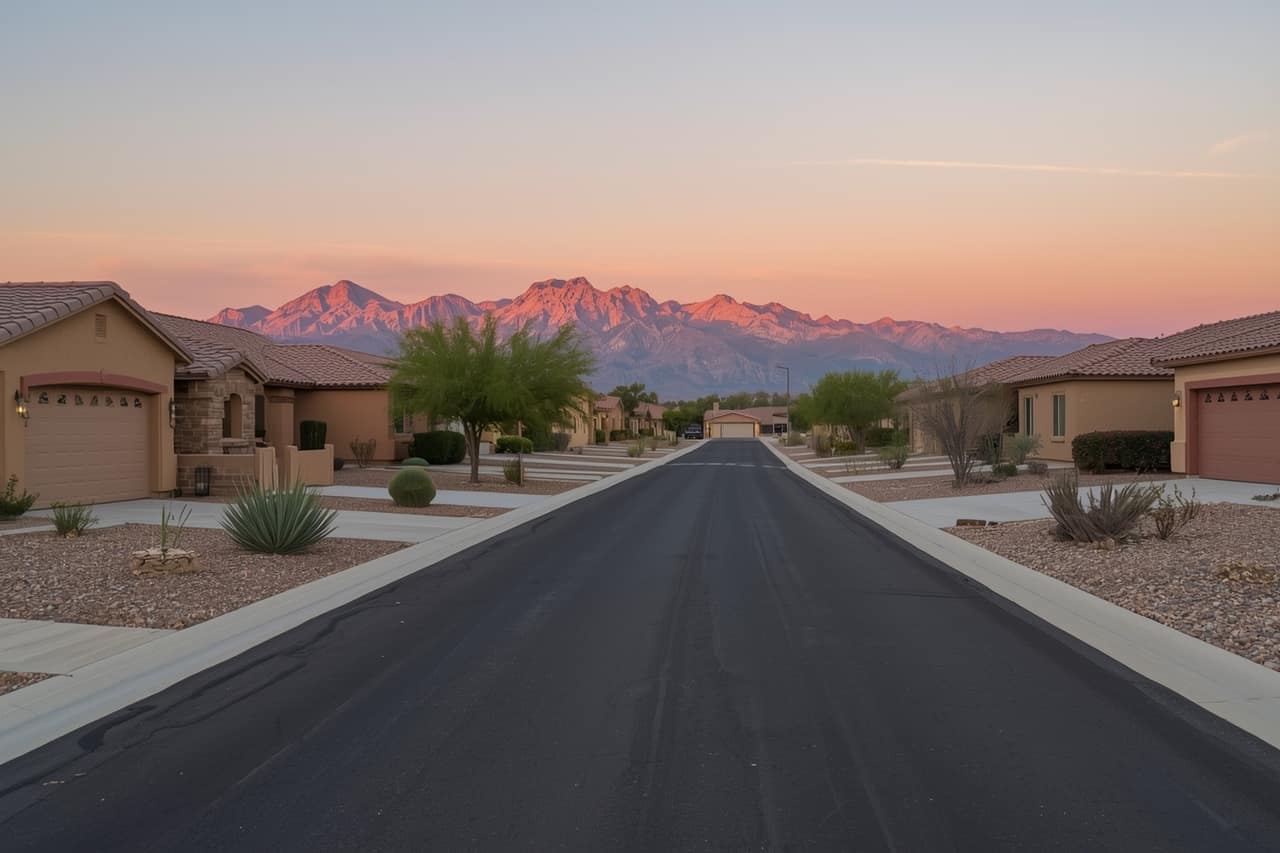
Bosque Garage Door puts Corrales residents in touch with a local garage door company, and the rest of this page covers garage door repair in Corrales, NM, a village that looks and feels different from the suburbs around it. If a door is stuck while you read this, call (505) 448-3665 and say you are in Corrales.
Corrales is a village in Sandoval County with an estimated 8,484 residents as of July 1, 2025. Its centroid sits at about 5,049 feet above sea level. The village keeps a rural character. The housing is older than in Rio Rancho and younger than in Los Ranchos: the median home dates to 1986, about 37 percent of the 3,940 housing units were built before 1980, and about 20 percent in 2000 or later.
Water, ditches and the bosque
The Rio Grande bosque, the wooded strip along the river, runs along Corrales's east edge, and a system of acequias, the old irrigation ditches, moves river water to fields and pasture. Acequias are a large part of why Corrales is known as an agricultural oasis. For a garage door the point is modest but real. Properties near ditches and irrigated land often have damper ground, more leaves and organic debris, and in some places standing water after heavy rain.
That kind of environment is hard on the bottom of a door. The lower panel, the bottom bracket and the weatherstripping sit closest to the slab, so they collect moisture and rust first. If the bottom seal has gone stiff or the lowest hinge looks pitted, it is a sign to look at the whole bottom row. A technician can tell you whether the seal alone or the whole panel needs work. If you have a detached garage or a barn on your property, remember that a separate building often needs its own power for an opener, and its door is more exposed to wind.
What 1980s doors are like
A median build year of 1986 means a typical Corrales garage was framed and fitted close to forty years ago. The door that is there today may be the original, or it may be a replacement from the 1990s or 2000s. Original doors from the 1980s are frequently one of two types, sectional steel or wood, and they are heavy. Wood sections soak up moisture over decades, which makes the door heavier than the spring was set for, and that mismatch is a common reason a spring breaks early.
Springs on a door of this vintage are often extension springs, the pair that run along the horizontal tracks, though some houses have torsion systems. If your door has extension springs, look for a thin steel cable running through the middle of each spring. It is a safety cable, and its job is to keep a snapped spring from whipping across the garage. If it is missing, that is a good reason to ask a local company to look at the door soon. Spring repair explains the two systems and why a pair should be replaced together.
An opener from the 1980s or early 1990s can predate both photo-eye sensors and battery backup. If your opener has no sensors near the floor, the door depends on a force setting alone to stop when it meets something, and that is the opener safety feature most worth upgrading. For repair versus replacement, see opener repair and opener installation.
Wind off the river and dust warnings
The National Weather Service's March 2025 Dust Storm Warning listed Corrales among the places expecting very strong winds and dense blowing dust, with visibility below a quarter mile. Spring brings the most wind, and the strongest events often have a westerly component. A warning is called when gusts reach 58 mph.
A wide, open door facing the wind takes the worst of it; trees near the river can add debris on a gusty day. After a storm, check that the door runs freely and that nothing has bent. The track that holds the rollers is the part most easily knocked out of line. The high desert wind and dust guide has a longer checklist.
Monsoon storms arrive between mid-June and the end of September, delivering an average of 4.47 inches around the Albuquerque area, and July at the Sunport normally brings 1.64 inches. At about 5,049 feet, Corrales sees a temperature swing much like the Sunport's, where July afternoons average 91 degrees and January nights 26, and metal parts, seals and springs flex through that range every day.
Permits and the village
Before any work bigger than a repair, call the village Planning and Zoning office and ask whether your project needs a permit. A rural village can have its own rules about structures, lot use and setbacks, and a new detached garage or a wider opening is the kind of change that deserves a call first. If your property is under neighborhood covenants, check them before ordering a new door too, since many limit color and style.
State permit rules apply as a baseline. The Construction Industries Division's residential permit guide says no building may be erected, altered, repaired or improved without a permit except for a short exempt list, and that list does not include garage doors. In other words, the state does not say yes or no for a door specifically.
Who is qualified to do the work
Before hiring, look up the company in the CID database. The rules do not list garage doors by name, and a narrow handyman exception limits who can work without a license: it caps yearly earnings, bars advertising and excludes electrical work. Verify the license through the lookup. Bosque only makes the introduction, and any license belongs to the company that comes out.
Choices when a door is this old
When a door from the 1980s starts to fail, a repair costs less than a door but may not be the end of the story. A new spring on a door with tired panels, rusted hinges and a worn opener may buy a few seasons. Replacing the door at the same time takes more at once but resets the clock on springs, cables, rollers and seals.
For a rough sense of scale, general national ranges put a torsion spring pair at about $200 to $450 and a standard door installation at about $1,200 to $2,500. Those are national figures, not Corrales prices, and a local company will give the real number once it sees the door. The garage door installation page helps you plan a replacement, and the cost guide lists what pushes a quote up.
Neighbors worth a look: Bernalillo is north along the river, and Albuquerque's neighborhoods are to the south. For a broader view of repair work, read cable and roller repair.
Before you call
A few details help whichever company picks up. Say whether the door is wood or steel, whether the garage is attached or detached, and how old the house is. Mention a ditch or damp ground near the slab if there is one, since that points to the bottom seal and brackets. Photograph the springs and the label on the opener, and note whether the door stopped partway up or will not move at all. If you have a long gravel drive or a gate, give the access details so the technician arrives with the right parts and no surprises.
Rural properties sometimes have garages that were added to the house in a later decade, and the door and the opener may not match in age. That is worth saying on the phone. A newer opener on a heavy old door is a common pairing, and it can explain why the opener strains.
Keeping an older door going
If you decide to keep a door from the 1980s, a little attention extends its life. Look at the hinges where they meet the panels, because old screw holes in wood or thin steel strip out and let a panel sag. Check the cables at the bottom corners for broken strands, and the rollers for cracks. Keep the bottom seal soft and flat, since a stiff seal leaves a gap that lets in water and wind. Do not adjust the springs or loosen the bottom brackets yourself, because both hold the door's full weight. A seasonal visual check, ideally before the spring wind and again before the monsoon, catches most problems while they are still small and inexpensive.