
Bosque Garage Door connects homeowners across the Albuquerque, New Mexico metro with a local garage door company for garage door opener installation in Albuquerque and the surrounding towns. Call (505) 448-3665 to describe your door and what you want from an opener. The call connects you with an independent local garage door company, and a quote for the work is something to ask for after a technician has seen the door.
An opener is the one part of a garage door system you use every day without thinking about it, until the day you do. Choosing one is less about brand than about fit: the weight of the door, the height of the ceiling, how you use the garage, and what you want to happen when the power goes out. This page works through those choices in the order a technician would, so you arrive at the conversation knowing what to ask for.
Do you need a new opener, or a repair?
If you already have an opener that has started to misbehave, the first question is whether replacing it makes sense. A newer opener is worth the money when:
- the current unit predates 1993 and lacks photo-eye sensors;
- the board or motor has failed on a unit that is more than ten or fifteen years old;
- repairs have started to arrive every year or so;
- the remote system is outdated and new remotes are hard to find;
- you want a quieter motor, better lighting, a keypad, battery backup or phone control.
If the unit is newer and a single part has failed, repair is usually better. The opener repair page helps sort that out. Also check the door itself. A new opener on a door with a broken spring or a worn cable will not work properly, so fix door problems first or at the same visit. The spring repair and cable, roller and panel repair pages cover those.
If you have no opener and the door lifts by hand, installing one is a standard job, as long as the door is in good balance. A door that does not stay put at about waist height needs spring work first.
Fit the opener to the door
Several facts about your door and garage steer the choice before any feature does.
Weight. A single steel door is light. An insulated double door, a wood door or a door with glass panels is heavy. Lifting capacity is rated for the opener's motor. A heavy door on a weak motor wears the unit out early.
Size. A seven-foot-high, sixteen-foot-wide door needs a stronger setup than a standard single. Eight-foot-high doors need a longer rail. Some openers come with a rail for seven feet, and an extension kit is needed beyond that.
Ceiling height and headroom. Ceiling-mounted openers need space above the door when it is open, and low headroom narrows the options. If your door opens into a high ceiling, the opener may need a longer rail or a different mounting.
Torsion or extension springs. Jackshaft (wall-mount) openers require a torsion shaft above the door. They are not an option for extension spring doors.
Garage layout. A one-piece tilt-up door, a carriage-style door that swings or a door in a detached barn each needs a specific opener or hardware. Mention the style when you call.
Reinforcement. Lightweight steel doors and some fiberglass doors need a reinforcement bar across the top section so the opener does not bend it. If the door has been opened by hand for years, the top panel may have no reinforcement.
A technician looks at all of this on site. You can speed the visit by measuring the door's width and height, and noting the ceiling height.
Chain, belt, screw and wall-mount drives compared
The drive is how the motor moves the door. Each type has a personality.
Chain drive. The traditional choice. A metal chain pulls a trolley along a rail. Chain drives are strong and usually the lowest in price. They are also the loudest, and the noise carries into rooms above or beside the garage.
Belt drive. A reinforced rubber belt replaces the chain. It is much quieter and smoother, and a good choice when a bedroom sits over the garage. Belt units cost more and have a similar lifespan.
Screw drive. A threaded steel rod moves the trolley. Fewer moving parts means less maintenance, but the screw is sensitive to temperature changes and can be noisy at the start of a cycle. Cold mornings tend to make them stiffer.
Wall-mount (jackshaft). The motor sits on the wall beside the door and turns the torsion shaft directly. There is no rail in the ceiling, which frees headroom for storage, lifts or a taller door. A wall-mount unit costs more and needs a torsion spring door with enough side clearance. Quiet operation and a clean ceiling are the main attractions.
Direct comparison. For a typical two-car garage with a bedroom nearby, belt drive is the common pick. For a detached shop where noise is irrelevant and cost matters, chain is common. For a garage with a car lift, a high ceiling, or storage racks overhead, a wall-mount unit is worth looking at.
Power: horsepower and DC motors
Openers advertise horsepower, and the numbers can be misleading. The ratings of one-half, three-quarters and one horsepower are often peak figures. What matters is lifting capacity and how the motor handles the load.
For most standard doors, a one-half horsepower unit has enough power, as long as the door is balanced. A heavier insulated double door or a door over eight feet benefits from more. Remember that the spring does most of the lifting. The opener is a guide. A larger motor will not make a poorly balanced door work well.
DC motors. Many modern openers use DC motors with soft start and soft stop. The door begins and ends movement gently, which reduces noise and strain on the hardware. DC units tend to be quieter and are often paired with belt drives. They also tend to cost more.
AC motors. Simpler and lower in price, with a firmer start and stop. A good fit for a utility garage.
Smart control, keypads and remotes
Newer openers connect to a home network, and many work with a phone app that opens and closes the door, shows its status and sends alerts. Some pair with voice assistants. Others work with in-vehicle systems.
Points to weigh:
- App control is convenient for letting in a delivery or checking that the door is closed. It depends on a stable wifi signal in the garage, which is often weak. Ask whether the unit needs a range extender.
- Keypads let you open the door without a remote. A wireless keypad is a good choice for kids, guests and dog walkers.
- Rolling code security. Modern remotes change their code with each use, which protects against copying. Older fixed-code remotes are not secure.
- Compatibility with your vehicles. If a car has a built-in transmitter, check that the new opener supports it.
- Delivery and package services. Some systems offer a way for a delivery driver to open the door. Think carefully about whether you want that, and read how it works.
An opener you cannot control from a phone still works fine. Smart features are a choice, and they raise the price.
Battery backup
Many openers include a battery backup that keeps the door working when the power is out. A garage door that will not open during an outage can trap a vehicle, and a door that cannot be closed leaves the garage open. The red release cord lets you move the door by hand, but a battery makes it unnecessary. If your area loses power during a windstorm or a monsoon storm, a backup is worth considering. Ask what the battery is rated for, how many cycles it provides and how long it lasts before replacement.
Some jurisdictions require backup batteries on new openers. A technician can tell you whether this applies to your installation.
Safety features
Whatever you buy, make sure it has the features that matter.
- Photo-eye sensors that reverse the door when something breaks the beam. These have been required on openers since 1993.
- Auto-reverse on contact. The door must reverse when it meets resistance on the way down. The technician should test this with an object, such as a board laid flat under the door.
- A manual release that works from inside the garage and, on some models, from outside.
- Lighting that stays on for a minute or so after use.
- A lock mode on the wall control, useful for vacations.
Ask the technician to test the reversal in front of you before they leave.
What installation day looks like
A typical installation takes a few hours for a standard opener, and longer for a wall-mount unit or an unusual layout. The sequence goes like this.
- Inspect the door. The technician checks balance, tracks, rollers and the top panel. If the door is out of balance or the springs are worn, it needs attention before the opener goes on.
- Remove the old unit. If there is an existing opener, it comes down along with its rail, brackets and wiring.
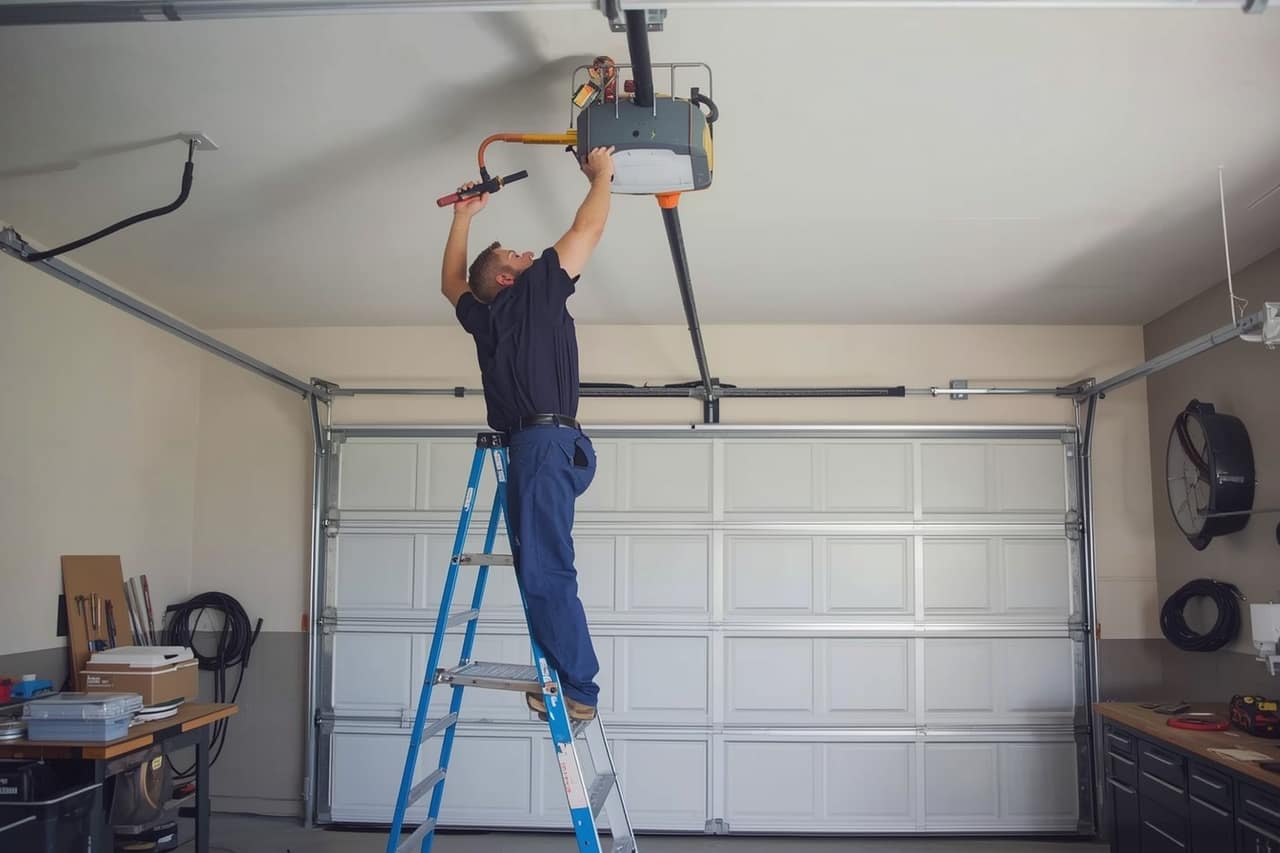
- Mount the header bracket and rail. The rail is assembled, the header bracket is fixed to the wall above the door, and the motor head is hung from the ceiling.
- Attach the trolley and arm. The arm connects the trolley to the door, usually through a bracket on the top panel.
- Wire the sensors and the wall control. The sensors mount near the floor on each side of the door, and thin wires run back to the motor.
- Connect power. Most openers plug into a standard outlet on the ceiling. If there is none, one has to be installed.
- Set limits and force. The limits mark how far the door opens and closes, and the force setting controls how hard the opener pushes.
- Test the safety systems. The reversal and the sensors are tested.
- Program remotes and keypads. The technician pairs everything and shows you how the system works.
Ask for the manual, the model number and the registration information before the technician leaves.
Power and wiring
Most openers plug into a grounded outlet near the motor head. If there is no outlet on the ceiling, one has to be added, and that is electrical work. New Mexico licenses electrical work separately from other trades. Whether an installer's license covers wiring an outlet is not always clear, so ask who is doing the electrical work and how it is permitted. Avoid extension cords for a permanent installation.
The state's rules do not list garage doors as their own contractor classification. The closest named classification is GS-14, windows, doors and skylights, and GS-29 is a miscellaneous classification for work that fits no list. Ask the company which classification covers the work, and look up the license on the state verification page before the visit. Ask for the license number.
Permits and local rules
Rules differ by city, and garage door openers are not named on the permit pages. Albuquerque's Express Permitting page lists small repairs and minor alterations, such as window or door replacements, as an express permit type, and the city's plan review office can answer questions at 505-924-3320, option 2. Rio Rancho says permits are required for most minor repairs and remodel work, and asks homeowners to call 505-891-5005 before starting. Los Lunas and Bernalillo route building permits through the state Construction Industries Division. If you are replacing a door and an opener together, ask the company whether a permit applies and who pulls it. Homeowners in an association should also check the covenants. Master-planned communities in Rio Rancho and Albuquerque often have homeowner associations, so confirm whether yours has rules about door changes.
Cold, wind, dust and high ceilings
Climate does not change which opener you pick as much as it changes how well the opener lives.
Cold mornings. The Albuquerque Sunport has a January average low near 26 degrees Fahrenheit, and Sandia Park in the East Mountains averages near 19. Edgewood, at about 6,700 feet, is higher still. Cold thickens grease and stiffens the drive. DC motors with soft start handle cold mornings better than simple AC units, and a belt drive tends to behave better than a screw drive in a garage that is not heated. If your garage is unheated and you live toward the mountains or the East Mountains, mention it when you choose.
Wind and dust. Spring is the windiest season in the metro, and blowing dust is common, with a National Weather Service dust storm warning in March 2025 naming Albuquerque, Rio Rancho, Corrales and other places. Dust works into the rail, the trolley and the sensor lenses. A sealed or enclosed drive and a simple wipe-down routine help. A door that gets pushed around by gusts also stresses the opener, so make sure the door itself is in good shape.
Sun. Strong sun fades plastic housings and dries wire insulation over many years. It can also shine into a sensor eye at a low angle. Placing the eyes with the sun in mind helps.
Ceilings. Garage ceilings vary widely across the metro, from mid-century houses in the Northeast Heights to newer stucco homes in Rio Rancho. If you plan overhead storage, a wall-mount opener frees the space.
Detached garages and outbuildings. A garage or shop away from the house may have weak wifi, no outlet where you need it and a long run of wire. Say so when you call, because it affects both the model and the cost.
Power outages during storms. Windstorms and summer monsoon storms can interrupt power. A battery backup is more useful if outages are part of your routine.
What moves the price
These are general national ranges, not Albuquerque prices. One national cost guide published in 2026 puts a standard opener at about $250 to $600 installed, and a smart opener with extra features at about $600 to $1,200. Another guide puts installed openers at about $220 to $520. A local company gives the real price after looking at the door.
What changes the price:
- Drive type. Chain is usually lowest, belt costs more, wall-mount costs the most.
- Motor and features. DC motors, battery backup, app control and keypads each add cost.
- Door condition. A door that needs a reinforcement bar, spring work or new brackets adds parts and time.
- Electrical. A new outlet or a longer wire run adds cost.
- Rail length. Taller doors need extension kits.
- Old unit removal. Some quotes include haul-away and some do not.
- Timing. Hours outside the normal schedule often cost more.
Ask for a quote that lists the model, what is included and what is not.
Questions to ask about a new opener
- What model and drive type are you proposing, and why for my door?
- What is the lifting capacity, and is a stronger motor needed?
- Does the quote include a new rail, brackets, sensors, wall control and remotes?
- Is a reinforcement bar needed on my door?
- Who does the electrical work, and is an outlet included?
- Does the price include haul-away of the old unit?
- Is the installer testing the auto-reverse in front of me?
- What about the parts and labor is covered in writing, and for how long?
- Does it work with the vehicles and phones we already have?
Compare at least two quotes, if you can, by the same measures.
Where this service is available
Opener installation is available through the local company reached at (505) 448-3665 across the metro, including Albuquerque, Rio Rancho, Corrales, Bernalillo and Los Lunas. If you are also considering a new door, the garage door installation page covers that, and the repair cost guide helps with budgeting.