
Updated 2026-11-20
A garage door is the largest moving part of most homes, and in the Albuquerque area it works in a climate that tests it. The metro sits at roughly 5,000 feet, climbing to about 6,700 feet out toward Edgewood, and it gets hard spring wind, fine blowing dust, strong sun, a wide gap between day and night temperatures, summer thunderstorms and winter cold. Bosque Garage Door connects homeowners across the Albuquerque, New Mexico metro with a local garage door company, and this guide explains what that weather does to a door and what you can check yourself.
Every number here comes from a primary source such as the National Weather Service, NOAA or a city or state page, and each is linked. Where a figure is not available, the guide says so rather than guessing. For prices, see the garage door repair cost guide. To talk to a local company about a problem, call (505) 448-3665.
Spring wind season
Spring is the hardest season for garage doors in the metro. The National Weather Service Albuquerque office says spring is the windiest time of year, that the spring wind maximum shows up at all of its monitored sites, and that high wind events are most common in spring and often have a westerly component. Its page lists April and May as the peak months, with March and June close behind. A High Wind Warning is issued for sustained winds of 40 miles per hour or more, or gusts of 58 miles per hour or more (NWS Albuquerque, high wind).
A garage door is a large flat panel with an opening behind it. A west wind pushes on the face of the door, and a gust can load the sections, the hinges and the track unevenly. Doors take the most punishment at three moments.
- When the door is partway up or down. A door that is stopped halfway is held by its rollers and tracks, and a gust can twist the lower sections out of the channel.
- When the door is closed but not well supported. Thin, single-layer panels flex. Hinges and horizontal struts do the work of holding the panels flat.
- When the door is open. A door that rests up in its overhead position acts like a sail for blowing debris.
What wind does to each part:
- Rollers and tracks. Side loads push rollers against one side of the channel, wearing the tire and the stem. A track whose brackets have loosened lets the whole line shift.
- Hinges and brackets. Repeated flexing stretches hinge holes and loosens fasteners.
- Panels. Wind can flex a weak panel enough to crease it near a hinge or strut.
- Seals. A bottom seal that is cracked or pulled out of its channel lets wind and dust blow in.
- Cables and drums. If the door twists, a cable can jump or fray.
- The opener. Wind pushing against the door raises the force the opener must use, and a door that fights the opener can trip its limit and reverse.
If a gust has already pushed a door off its line, read the page on off-track door repair. If the door will not move at all, see emergency garage door repair.
Habits for wind days
- Close the door fully when a High Wind Warning or a strong wind forecast is in effect.
- Do not leave the door partway open for ventilation.
- Do not run the opener on a door that scrapes, leans or drags.
- After a gust that rattled the door, look at it from inside. A roller out of line, a visible gap or a sagging corner is a reason to stop and call.
- Park vehicles so that an open door cannot be struck by a gust-driven door swing or by flying debris.
Blowing dust
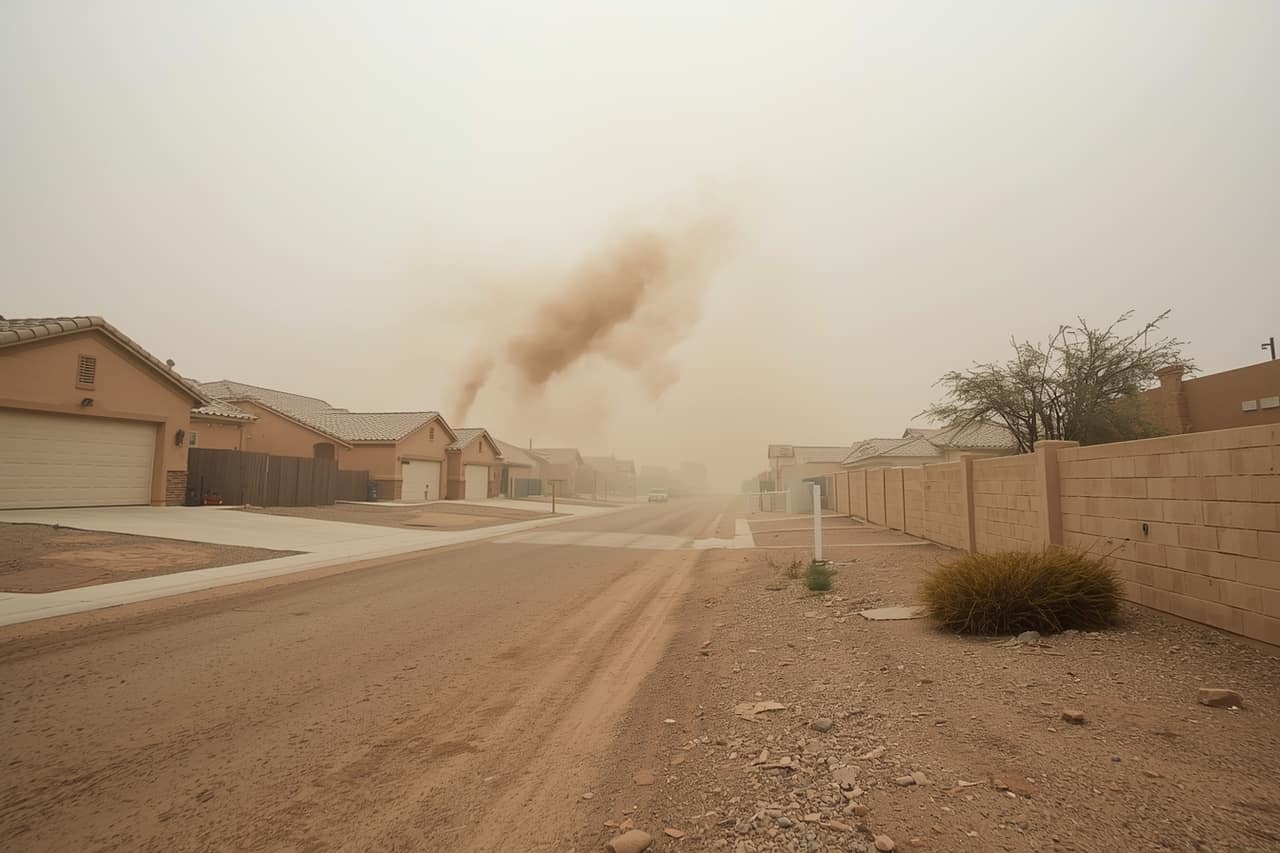
Dust in the metro arrives in two ways: as a constant background of fine grit, and as dramatic events. On March 18, 2025 the National Weather Service issued a Dust Storm Warning for Bernalillo County, describing very strong winds and an area of dense blowing dust across the metro area, with visibility under a quarter of a mile. The warning named Albuquerque, Rio Rancho, Corrales, Los Ranchos, Tijeras, Paradise Hills and Sandia Heights (National Weather Service Albuquerque, Dust Storm Warning of March 18, 2025).
The city of Rio Rancho also notes that it maintains dirt roads within city limits as the budget and conditions allow, grading busy ones weekly or biweekly and others monthly, with storms able to disrupt the schedule (City of Rio Rancho, dirt roads). That is a reminder that some neighborhoods live with more loose dirt than others. The link between dirt roads and door wear is not something the city states, but grit has to go somewhere, and a garage that opens onto an unpaved or dusty approach collects it.
What dust does:
- Tracks. Dust mixes with old lubricant into a gritty paste that gives rollers something to ride up on.
- Rollers. Grit in the bearing makes it grind and flatten. A roller that squeals or wobbles is often a dusty one.
- Hinges and pivots. Dust sticks to wet lubricant and acts like sandpaper.
- Photo-eye sensors. A film of dust on the lens can interrupt the beam, and the door refuses to close or reverses for no obvious reason.
- Opener internals. The chain, belt or screw collects grit, and the motor housing can clog.
- Seals. A worn bottom seal lets fine dust drift into the garage and onto the floor and anything stored there.
- Finish. Dust under wind can abrade a thin paint film, especially along the lower edge.
Habits for dusty weather
- Wipe the photo-eye lenses with a soft dry cloth after a dust event.
- Wipe the track with a dry or slightly damp cloth, not a heavy degreaser. Do not spray lubricant into the track where the rollers ride unless a technician tells you your rollers call for it.
- Use a light lubricant on hinges, rollers' stems and springs only as a technician advises, then wipe off the excess so it does not catch dust.
- Check the bottom seal for gaps after dusty spells.
- Keep the area just inside the door swept so that dust does not get dragged into the sensors and tracks.
Strong sun at elevation
The metro sits high, from about 4,960 feet at the Albuquerque city center to about 6,700 feet at Edgewood according to U.S. Geological Survey elevation data. Sunlight at elevation passes through less air, and a south or west-facing garage door gets a lot of direct light on a clear day.
What sun does:
- Paint and finish. Ultraviolet light fades color and chalks the surface. Dark colors fade more visibly, and they also get hotter.
- Wood and wood-look finishes. Real wood dries, checks and opens at the joints, and the finish needs refreshing sooner than it would in a cloudy climate. Some manufacturers limit dark colors on certain doors, so ask before choosing a very dark shade.
- Plastic and rubber parts. Bottom seals, weatherstripping, cable guides and some roller tires get brittle and crack.
- Window inserts. Plastic glazing yellows and clouds.
- Opener housing and wiring. Sun through a window can heat the opener, and a thin wire jacket can crack where it is exposed.
- Lubricant. Heat thins some lubricants so they run off, and thickens others.
- The garage itself. Heat builds under a south-facing door, which raises the temperature around the opener and any stored items.
Habits for strong sun
- Wash the door with mild soap and water a couple of times a year. A clean, waxed finish holds up better than a chalky one.
- Touch up chips and scratches in steel before bare metal rusts.
- Refinish wood or wood-look doors on the schedule the maker gives.
- Look at the bottom seal and the weatherstripping every spring, and replace them when they crack or stiffen.
- Ask about UV-resistant finishes when choosing a new door. The installation page discusses colors for stucco homes and sun.
Large daily temperature swings
NOAA climate normals for 1991 to 2020 at the Albuquerque Sunport show an annual mean daily temperature range of 24.8 degrees Fahrenheit, and 29.0 degrees at Sandia Park in the East Mountains (NOAA 1991 to 2020 annual climate normals). At the Sunport, the July average high is 91.2 degrees and the average low is 66.5 degrees, while the January average high is 48.4 degrees and the low is 26.4 degrees (NOAA 1991 to 2020 monthly climate normals). That is the average. Any given day can swing further.
Metal expands when it warms and contracts when it cools, and rubber and plastic stiffen in the cold. Over a year, that adds up.
- Springs. Torsion and extension springs flex and cycle with every trip of the door, and temperature changes affect the metal's behavior. Springs wear out with use, and a door used several times a day wears them faster than one used once. Cold mornings are a common time for an aging spring to let go, though a spring can break at any time.
- Seals and weatherstripping. Rubber hardens in cold, shrinks and pulls away from the door, then softens in heat. A bottom seal that was snug in summer can show daylight in January.
- Tracks and brackets. Repeated expansion and contraction can loosen fasteners over many seasons.
- Lubricants. Some thicken in the cold and make a door sluggish or noisy. A technician can tell you what suits your parts.
- Openers. The opener's force and travel settings can drift between seasons. A door that closed perfectly in September may stop short in January because the seal stiffened.
- Insulated doors. Foam-filled panels slow the transfer of heat and keep the garage steadier. See new door installation and replacement for the choice between insulation levels.
Habits for swings
- Re-test the door's travel and auto-reverse when seasons change.
- Check the bottom seal in winter and summer.
- Listen for a door that strains, groans or moves unevenly on cold mornings, and do not ignore it.
- Have springs inspected if the door is old, heavy or used constantly. The spring repair page explains what failure looks like.
Monsoon storms
The National Weather Service Albuquerque office uses June 15 to September 30 as the monsoon season. The average monsoon rainfall in the Albuquerque area is 4.47 inches, with 9.42 inches in the wettest year on record (2006) and 1.46 inches in the driest (2003) (NWS Albuquerque, monsoon statistics). NOAA normals put July as the wettest month at the Sunport, at 1.64 inches, followed by August at 1.31 inches and September at 1.15 inches. Annual precipitation at the Sunport is 8.84 inches in total.
Those are not big numbers, but they arrive in short, hard bursts, and a thunderstorm can bring gusty wind ahead of the rain. A door that is open when one rolls in can take wind, rain and debris all at once.
What storms do:
- Water at the threshold. Sheet runoff from a driveway can run under a door with a worn seal. Water at the bottom edge can rust a steel panel at the base and swell a wood one.
- Rust. Moisture on exposed steel, especially at scratches and the lower edge, starts rust that dry months did not.
- Electrical risk. A wet garage with an opener, sensors and wiring needs attention. If water reaches the opener or outlets, turn off the power at the breaker and do not touch wet equipment.
- Power loss. A storm can knock out the power, and a door with a dead opener needs the release cord. Know how to use it, and know that it is only safe when the door is closed and the springs are intact.
- Lightning and surges. A surge can damage an opener's circuit board.
- Debris. Wind-driven branches and gravel can dent panels and jam the track.
Habits for monsoon season
- Close the door when storms are in the forecast.
- Look at the bottom seal before June, and replace it if it is cracked or flat.
- Grade or sweep any water that pools toward the door, and check that downspouts do not point at the threshold.
- Keep the garage floor near the door clear so that water has a path.
- Put the opener on a surge protector.
- Check that everyone in the household knows what the red release cord does.
East Mountains cold and snow
Homes in the East Mountains, such as those near Edgewood, Tijeras and Sandia Park, sit higher and colder than neighborhoods near the river. The USGS puts Edgewood's centroid at about 6,715 feet. At Sandia Park, NOAA normals show a January average high of 43.9 degrees and a low of 19.0 degrees, and December's average low is 18.1 degrees. Annual snowfall at the Sunport averages 7.9 inches. No snowfall normal is published for the Sandia Park station.
Cold and snow affect garage doors in specific ways.
- Frozen seals. A rubber bottom seal can freeze to a slab after melting snow refreezes. An opener that pulls the door up can then tear the seal.
- Ice in the track. Water that melts and refreezes in the track blocks the rollers.
- Heavier doors on cold mornings. Lubricant thickens and the opener works harder, so a marginal opener or spring shows its age first.
- Snow loads at the threshold. Drifts against a door add pressure.
- Brittle plastic. Cold makes plastic hinges, rollers and glazing more fragile.
- Longer garage use. Many people keep a vehicle and a workshop in the garage through winter, so the door is cycled often.
Habits for cold weather
- Clear snow and ice from the threshold before you run the door.
- If the door seems stuck, do not force the opener. Check the bottom seal and the track for ice first.
- Choose an insulated door for a garage that shares a wall with the house or doubles as a workspace.
- Check the weather seal and the perimeter strip before the first freeze.
Putting it together: what each season does to each part
Rather than a table, here is the pattern by part.
- Rollers: worn by wind loads and dust, stressed by cold. Check them every spring and fall.
- Tracks: fouled by dust, iced in winter. Clean them seasonally.
- Hinges and brackets: loosened by wind flexing and by temperature swings. Look for stretched holes and loose bolts.
- Seals and weatherstripping: cracked by sun, stiffened by cold, worn by dust. Replace them when they fail.
- Springs: worn by cycles, stressed by temperature swings. Have them inspected on older doors.
- Cables: frayed or jumped when a door twists in wind. Look for broken strands, but do not touch cables under tension.
- Panels: creased by wind, dented by debris, rusted by moisture. Touch up chips early.
- Finishes: faded by UV, scoured by dust. Wash and refinish on schedule.
- Openers: strained by wind and cold, clogged by dust, vulnerable to surges. Test them each season. See opener repair and opener installation.
- Sensors: blocked by dust, knocked out of line by bumps. Wipe the lenses and check alignment.
A seasonal checklist
None of this needs tools beyond a ladder-free look, a cloth and a piece of wood or a roll of paper towels. Do not touch the springs, the cable drums or the bottom brackets, and do not remove anything that is under tension.
Early spring, before the wind peaks
- Close the door and look along each side from inside. Daylight at one edge or a gap at the top suggests the door is not sitting square.
- Check rollers for wobble, flat spots and cracked tires.
- Check each hinge and bracket for loose bolts and stretched holes.
- Wipe the tracks clean.
- Inspect the bottom seal and perimeter weatherstripping.
- Test the auto-reverse by laying a board flat on the floor in the door's path. The door should reverse when it touches.
- Test the photo-eye sensors by waving an object through the beam while the door closes.
- Release the door from the opener only if it is closed, and lift it by hand to feel its balance. If it is heavy or lopsided, stop and call.
After a dust event or high wind
- Wipe the photo-eye lenses.
- Look for a roller out of line, a creased panel or a sagging corner.
- Listen to the first cycle for scraping or grinding.
- Sweep grit away from the threshold.
Early summer, before the monsoon
- Replace a cracked or flattened bottom seal.
- Check where water drains near the door.
- Confirm the opener is on a surge protector.
- Wash the door and touch up chips.
- Make sure everyone knows how the red release cord works, and when not to use it.
Fall, before the first freeze
- Test the travel limits and auto-reverse again.
- Look at the bottom seal and the weatherstripping.
- Ask a technician about lubricants suited to cold if the door runs stiff in winter.
- Have an older door's springs and cables inspected.
- Plan insulation for the garage if it is a workspace.
Winter
- Clear snow and ice from the threshold and track.
- Do not force a frozen door.
- Listen for a door that strains on cold mornings.
- Keep the opener's power, sensors and wiring dry.
When to stop and call
Some things are not part of a checklist. Call (505) 448-3665 and describe the problem if you see or hear any of these.
- A loud bang, or a door that suddenly feels heavy or will not lift.
- A roller out of the track, a sagging corner or a door hanging crooked. See off-track door repair.
- A frayed, slack or broken cable.
- A door that reverses, stops or stutters for no clear reason.
- A door that will not close and leaves the garage open. See emergency garage door repair.
- A door that is more than a few seasons old and has never been inspected.
The call connects you with an independent local garage door company serving Albuquerque, Rio Rancho, Corrales, Bernalillo and Los Lunas. Ask the company about the soonest visit it can offer, and ask for a price after it has looked at the door. For more on repairs, see cable and roller repair and spring repair.