
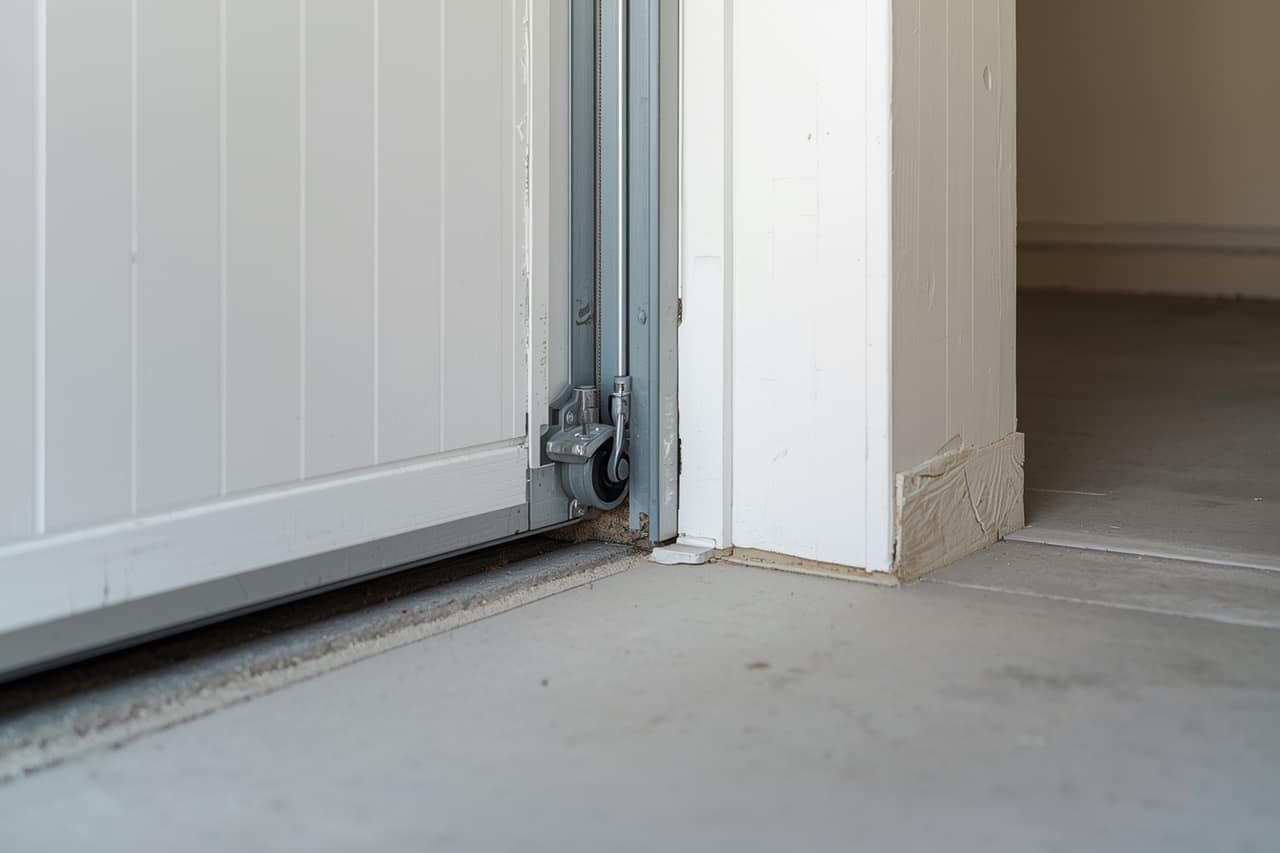
Bosque Garage Door connects homeowners across the Albuquerque, New Mexico metro with a local garage door company when a garage door is off track. If your door came out of its track this morning, or you walked into the garage and found one side drooping, you are probably looking at a door that is heavy, crooked and not safe to move. Take a breath, stay clear of it, and read the next section before you touch anything.
When you are ready, call (505) 448-3665 and describe what you see. The call reaches an independent local garage door company, and you can ask it about visit timing. If the door is stuck open, a vehicle is trapped inside, or you heard a bang before it went wrong, read the emergency garage door repair page too, because a broken spring or cable often sits behind what looks like a simple derailment.
First, do these things
A door that has jumped its track is lopsided while its springs and cables still carry tension. For now the only aim is to keep people and belongings out of harm's way.
- Stop using the door. Do not press the wall button, the remote or the keypad.
- Unplug the opener from its ceiling outlet if you can reach the cord from the floor without standing under the door. If you need a ladder to reach it, leave it and flip the breaker for the garage instead.
- Move cars, bikes and anything else out from under or beside the door if that can be done without lifting or pushing the door.
- Keep children and pets out of the garage.
- Take a photo or two from a safe distance. Show the whole door, and then the spot where a roller or corner has come out.
- Write down what happened just before. A bang, a crunch, a scrape, a gust of wind, a bumper tap. That detail helps the technician decide what to bring.
What not to do
Most of the cost in a simple derailment comes from what people do before the technician arrives. These are the moves that turn a re-rail into a new panel, a new door or an injury.
- Do not run the opener. The motor keeps pushing a crooked door, which can wedge it against the wall, a parked car or farther out of the track.
- Do not try to push, pry or hammer the door back into the track. The door can weigh well over a hundred pounds, and it can drop without warning.
- Do not pull the red emergency release cord if the door is halfway open. If a spring is broken, gravity takes over the moment the opener lets go.
- Do not stand, reach or park under the door while it hangs from one side.
- Do not loosen track brackets to "give the door room." Those brackets keep the track in line with the door.
- Do not touch the springs, the cable drums or the bottom brackets. Those parts hold the door's weight under tension and can injure a person badly.
- Do not tape, tie or wedge the door to hold it. If it shifts, a wedge turns into a projectile.
None of this is meant to scare you. It is the same list a technician would give you over the phone. The door looks like a simple mechanical problem, but the parts that hold it up are the dangerous ones.
Why a garage door comes off its track
Think of the door as a chain of small parts: wheels in steel channels, hinges between panels, brackets, and cables on both sides. Any one that weakens pushes extra load onto its neighbors, and the weakest link finally lets go. These are the usual culprits around Albuquerque.
A gust against a half-open door
Spring in the high desert brings strong, gusty days, and a door that is partway up is a large flat sail. A gust that catches it at the wrong moment can push the lower panels sideways, and a roller pops out of the channel. This is one of the common stories behind a derailment on a windy afternoon, and it is more likely when the door is left cracked open for ventilation or is stuck at a halfway point. If the door has loose hinges or a track that is slightly out of line, the wind needs less to do the same job. For more on how wind affects a door over the seasons, see the guide on wind, dust and sun and garage doors in the high desert.
A bump from a vehicle or equipment
A bumper, a trailer hitch, a lawn mower, a bike or a ladder striking the lower panel or the track may kink the track next to it and fold the lowest section. The door may run one more cycle and then come off the next time the opener moves it. The giveaway is a dent or kink near the bottom corner, often on the side where a car backs out.
Worn or failing rollers
Rollers wear. A tire that has cracked, a stem that has worn thin or a bearing that has flattened will not hold the channel. The door scrapes on one side, squeaks, jerks at the same point in each trip, and eventually a roller jumps out. Of all the causes this one develops slowly, and it tends to give weeks of warning. Nylon rollers and steel rollers wear differently, and a hard, grit-laden climate wears both faster than a clean, mild one.
A broken or slipping cable
Lift cables run from the bottom corners of the door up to the drums at the spring tube. If one cable breaks or slips off its drum, that side of the door loses support and drops. The other side is still held up, and the door twists in the track. This is a cable failure first, and a derailment second, and it needs a technician who deals with the whole lift system, not just the track.
A bent, loose or misaligned track
Tracks are fastened to the wall with brackets, and over time the screws can loosen, especially in a garage that sees large temperature swings and the occasional bump. A track that has worked its way out of true no longer matches the line of the rollers. Sometimes the door only sticks. Sometimes it jumps.
Dust, grit and old grease
A track full of packed dust and dried lubricant gives rollers something to ride up on. Dust in this region is fine, dry and persistent, and a garage that is open often collects a layer on every horizontal surface. A cleaned track and fresh, appropriate lubricant on the right parts take little time, but when rollers and the track have been fighting each other for a long time, the door pays for it.
A broken spring
A snapped spring does not usually cause a derailment by itself, but it makes every other cause worse. When a spring lets go, the door becomes much heavier on the opener and on the cables, and a cable may then jump the drum. If you heard a loud bang, treat it as a spring problem first and start with spring repair.
How serious is it?
You can learn a lot from a safe look, though only a technician can say for sure. These are the common situations, from easiest to hardest.
- One roller out, panels straight. The door hangs mostly level and only one roller has popped out of its channel. A technician can often free the door, check the track and the roller, replace what is worn and put the door back in service in one visit.
- A top corner sagging. The upper roller has left the channel and a top section leans in or out. This usually still re-rails, but the top section may have a bent hinge or a stretched panel edge that needs attention.
- A section creased or folded. If the bottom panel has bent where the track or a bumper pushed it, the technician will usually recommend replacing that section rather than putting a weak panel back on the track. A panel that does not match the others can be an issue on an older door, so ask about availability early.
- A track bent or pulled away from the wall. The track needs straightening or replacing. A track with a sharp crease is usually replaced because it keeps catching rollers.
- The door is on the floor or fell sideways. Treat this as an emergency page, not a repair-it-later page. Keep everyone away and call.
Photos help here. A local company that sees the photos can often tell you whether the job looks like a re-rail, a track and roller job, or a larger repair, and what to ask about before the visit.
What a re-rail involves
When a technician arrives, the first thing they do is make the door safe. The work usually follows the steps below, though the details change with the door.
- Secure the door. The technician clamps or props the door so it cannot fall, and releases the tension where needed. This step is the reason not to attempt a DIY re-rail.
- Check the lift system. Springs, cables, drums and bottom brackets are inspected, because a worn or damaged part there often caused the derailment.
- Remove damaged parts. Bent rollers, broken hinges, a damaged section or a bent track piece come off.
- Straighten or replace the track. A lightly bent track may be straightened and reset. A badly creased track is replaced.
- Reseat the rollers. Rollers are replaced where worn and set back in the channel. The door is brought back into line.
- Rebalance. The door's balance is tested by hand. A properly balanced door stays where it is left at about waist height and moves smoothly.
- Test the opener and safety features. The opener's travel limits, force settings and the auto-reverse and photo-eye sensors are tested and adjusted if the door's travel changed.
- Lubricate and clean. Moving parts receive appropriate lubricant, and the track is cleaned where needed.
A straightforward re-rail can take under an hour. A job with a bent track, a creased panel or cable work takes longer and may need a part ordered. Ask the company how long your repair is likely to take and whether the door can be left safely closed until the part arrives.
Choosing between repair and replacement
A derailment is one of the moments when it is worth asking what the door's condition really is. A few questions help.
- How old is the door, and how often has it needed repairs?
- Are the panels intact or creased in several places?
- Is the opener working well, or has it been struggling for a while?
- Is the door insulated, and do you want it to be?
- Does the door still match the look of your home and any HOA rules?
If the door is in good shape and one section or one track is the only damage, repair is almost always the better path. If sections are cracked, rusted or already patched, or the door is old enough that parts are hard to match, ask the company for both options. You can read more on new door installation and replacement, including what moves the price, and the garage door repair cost guide explains how local quotes are built.
Keeping a door on its track in a windy, dusty climate
Once the door is back on its track, a few habits make a second derailment less likely.
- Do not leave the door partway open on windy days. A door that is fully closed or fully open resists gusts far better than one stuck at a half position.
- Wipe the track clean. Use a dry or slightly damp cloth, not a degreaser spray that pushes dust deeper. Do not lubricate the inside of the track itself where the rollers run unless the roller type calls for it. A technician can tell you what suits your rollers.
- Look at the rollers twice a year. Chipped, flat or wobbling rollers are a warning.
- Check the hinges and brackets. A hinge with a stretched hole or a bracket that has loosened lets the door twist.
- Watch for rubbing on one side. A door that scrapes or drifts to one side is already telling you something.
- Stay alert to the opener. If the opener struggles, or the door reverses without reason, have the whole system looked at, not only the opener. See opener repair for the common causes.
A seasonal check does not need tools. Close the door, then look along the top and sides from inside. Light that shows through the seal at one corner is a hint that the door is not sitting square. The guide to wind, dust and sun on garage doors has a full seasonal checklist.
What to say when you call
A short, clear description gets the right company, with the right parts, to your door. When you call (505) 448-3665, be ready to say:
- Which side or corner is out, and whether the door is open, closed or in between.
- Whether you heard a bang or a crunch first.
- Whether the door is a single or double, steel or wood, insulated or not, if you know.
- Whether a car or other item is blocked in or under the door.
- Whether the door is moving at all, and whether you have used the opener since it happened.
- Your city, such as Albuquerque, Rio Rancho, Corrales, Bernalillo or Los Lunas.
You do not need to know the part names. A plain description and a couple of photos are enough.
What moves the price of an off-track repair
Every door and every derailment is different, so the local company prices the job after it looks at the door. The factors that matter most are these.
- The number of damaged parts. One bent roller is a small job. A roller, a hinge, a section and a track is a larger one.
- Panel damage. A creased section is often the biggest variable, especially if it has to be matched to an older door.
- Cable and spring involvement. If a cable or spring is part of the story, the visit includes that work.
- Door size and weight. A double door with insulated panels is heavier and takes more care.
- Access and timing. Whether the door is stuck open, stuck closed or on the ground, and the time of day the visit needs to happen.
- Parts availability. Common rollers and hinges are easy. A special section or a rare track profile may take time.
For the general national ranges and more on how quotes are built, see the repair cost guide. Real Albuquerque prices come from the local company after it looks at your door, not from a web page.