
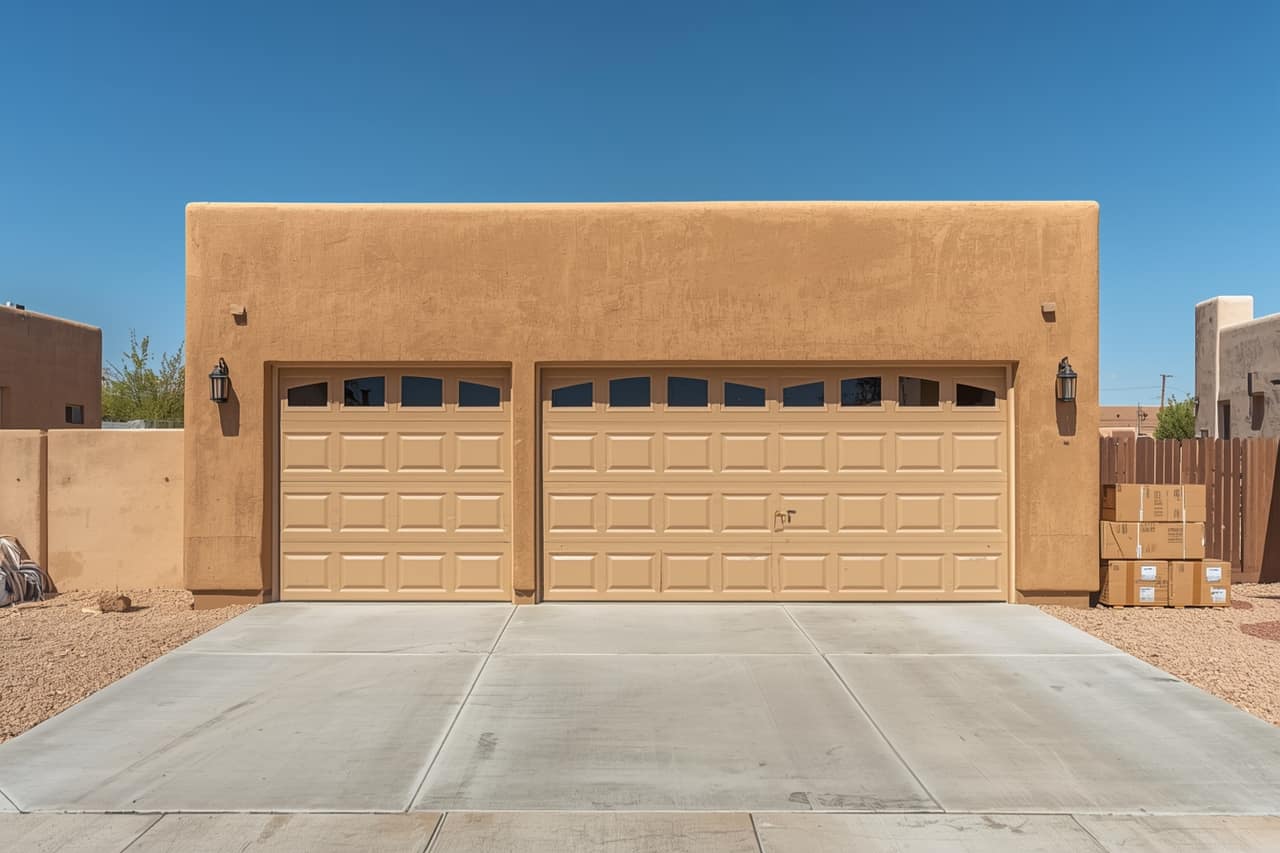
Bosque Garage Door connects homeowners across the Albuquerque, New Mexico metro with a local garage door company for garage door installation in Albuquerque and the towns around it, including full replacement of a worn or damaged door. A new garage door is one of the largest visible parts of your house, and in a city of stucco, flat roofs and strong sun, it has to look right and hold up to wind, dust and big temperature swings. This page walks through the decisions in the order most people face them.
When you are ready to talk it over, call (505) 448-3665 and describe the door you have and what you want. The call connects you with an independent local garage door company. Ask that company to look at the opening, go through the options and price your specific door. This page cannot do that for you, and it does not quote prices. For general national ranges, see the garage door repair cost guide.
Repair or replace: how to decide
Not every worn door needs replacing, and not every repair is worth doing. A few questions sort it out.
Signs that repair makes sense
- The damage is limited to one part: a spring, a cable, a roller set, a sensor, a section.
- The door is otherwise straight, quiet and well balanced.
- The panels are intact and the finish is in decent shape.
- Replacement parts are easy to find.
- The door matches your home and you like it.
Signs that replacement is worth pricing
- More than one section is dented, cracked, rusted or delaminating.
- The door has been repaired several times in a short period.
- Panels have bowed, or the door sags between hinges.
- The door is uninsulated and the garage is part of your living space, such as a workshop, gym or office.
- Parts for an older door are hard to find, or a replacement section will not match the others.
- The opener is also old, and you plan to replace both, since a new door and opener are often fitted together.
- The door is a style you never liked, or the HOA is asking you to refresh the front of the house.
- An accident, a storm or a failed spring has already damaged several parts at once.
A fair local company will tell you honestly which side your door is on. If a technician recommends replacement after a single failed spring on an otherwise sound door, ask why. The reverse also applies. If the door is twenty-some years old and the visit is the third repair this year, replacement may cost less over time.
You can read about common repairs on the spring repair, opener repair and off-track door repair pages.
Door types to compare
Garage doors are built from a few basic materials and styles, and most homes in the area end up choosing among the following.
Steel doors
Steel is the common choice. A steel door is made of sections stamped and painted at the factory, and it comes in single-layer, and two or three-layer constructions. A single-layer steel door is the lightest and the simplest, but it offers no insulation and it dents easily. Steel is easy to maintain and holds paint well. The weak points are dents from impact and rust where the paint is scratched, so a hard knock deserves a touch-up before a bare spot starts to rust.
Insulated steel doors
An insulated steel door has foam between two steel skins, or foam glued to a single skin. The foam stiffens the door, quiets it and slows heat transfer. Foam comes as polystyrene (rigid panels) or polyurethane (injected foam that sticks to the steel). Polyurethane usually gives a higher R-value and a stiffer door. The extra stiffness helps in wind.
Wood-look and composite doors
Some homeowners want the warmth of real wood without the upkeep. Steel and composite doors can carry a wood-grain finish, and they are designed to look like stained cedar or fir from the street. Real wood has its own character, but in a place with high UV, a dry climate and dust, it needs regular refinishing and moves with the seasons. Wood-look steel and composite are often chosen for homes where the garage faces the street, and for areas where an HOA wants a natural look.
Carriage style
Carriage style doors mimic the swing-out barn doors of an earlier era, with decorative hinges, handles and window inserts, but they open on tracks like any sectional door. They suit Territorial and Southwestern homes well, and they blend with timber lintels and vigas. They tend to have more panel detail and sometimes more hardware to inspect.
Full-view doors
Full-view doors use wide aluminum frames with glass panels, often tinted or frosted. They look modern and bring in light. They work for contemporary and mid-century homes, and for workshops or studios where daylight matters. In a high-sun area, they ask more of the glazing and the seals. Ask about glass type, privacy and heat gain, and about how the sections are reinforced against wind.
Raised panel versus flush
Raised panel doors have a pattern of rectangles. Flush doors are smooth. The choice is mostly about looks, but a flush panel shows dents and wind-driven dust marks more, and a raised panel hides small flaws. Some modern flat-panel styles suit stucco homes with clean lines.
Insulation and R-value in high-desert heat and cold
Albuquerque is not a place where you can ignore insulation. The metro sees hot summer afternoons and winter nights that fall well below freezing, and National Weather Service and NOAA records show a wide gap between daily highs and lows. According to NOAA 1991 to 2020 normals for the Albuquerque Sunport, the July average high is about 91 degrees and the January average low is about 26 degrees, and the average daily range over the year is close to 25 degrees. In the East Mountains, near Sandia Park, the normal January low is about 19 degrees.
What does that mean for a door?
- An attached garage shares walls with your house. An uninsulated door lets the garage swing hard with the weather, and the wall between the garage and the living space then loses or gains heat. Insulation narrows the swing.
- A garage used as workshop, gym or office benefits the most from an insulated door with good seals.
- A detached garage or shed often needs less. If you only park a car, a basic door may do.
- Insulation also stiffens the door. Foam-filled sections resist flexing in a gust, which matters in spring.
- Insulated doors are quieter. The foam damps vibration.
What R-value tells you, and what it does not
R-value measures resistance to heat flow through a material. Higher is better, but it is not the whole story. The number printed on a brochure is usually for the panel alone. A door loses heat at the seals, the gaps between sections and the top and sides, and an R-value on the label does not account for that. Ratings you will see on residential doors run from none for an uninsulated steel door to well into the teens for a thick polyurethane door. Ask the installer what the number refers to and what they will do about the perimeter seals. Do not pay for a higher number if the opening is going to leak around the edges.
A reasonable path: pick an insulation level for how you use the garage, then spend the rest of your attention on seals and installation. A well-sealed R-6 door can beat a poorly fitted R-16 door in the field.
Wind and dust seals
Spring is the windiest season in the metro. The National Weather Service Albuquerque office reports that high wind events are most common in spring and often come from the west, and it uses a High Wind Warning threshold of sustained winds of 40 miles per hour or more, or gusts of 58 miles per hour or more (NWS Albuquerque, high wind). A March 2025 Dust Storm Warning named Albuquerque, Rio Rancho, Corrales, Los Ranchos and other parts of the metro (NWS Albuquerque Dust Storm Warning, March 18, 2025).
A garage door has to deal with that every spring. When you compare doors and quotes, ask about:
- Bottom seal. The rubber or vinyl strip along the bottom edge. Look for one that is easy to replace, because it gets abused. A flexible seal that follows the slab keeps out dust and water.
- Perimeter weatherstripping. Strips on the jambs and the top that close the gap between the door and the frame. Ask whether they are included.
- Section joints. Some doors have thermal breaks or interlocking edges that reduce gaps between sections.
- Wind rating or reinforcement. Ask whether the door has horizontal struts, a wind-load rating or a heavier-gauge steel option. A wind-rated door has been tested to a stated load. If a listing claims a rating, ask to see where the rating is documented for that model.
- Track and hardware. Track gauge, number of hinges and roller type affect how well a door handles stress.
- Threshold. A flat, sealed threshold helps with dust. If your slab is uneven, ask how the installer plans to handle it.
For more on how wind, dust and sun age a door over time, see the guide to wind, dust and sun and garage doors in the high desert.
Colors that suit stucco and Pueblo Revival homes
Many homes in the metro are finished in stucco in shades of tan, sand, adobe, terracotta and cream, and the Pueblo Revival and Territorial styles are common in places such as Old Town, Nob Hill and Los Ranchos. The goal is a door that looks like part of the house, not a separate object.
- Match the trim, not the wall. A door a shade or two darker than the stucco looks deliberate. Matching the wall exactly can look flat, while a strong contrast draws attention to the door.
- Earth tones fit. Browns, tans, clay and muted greens suit many stucco colors.
- Dark colors absorb heat. In strong sun, very dark doors get hot, and some finishes fade faster. If you like a dark color, ask about finishes made for sun and heat and whether the manufacturer limits dark colors on certain doors.
- Wood-look finishes pair well with timber details. If you have vigas, lintels or a wood front door, a wood-look garage door can tie them together.
- Windows suit some styles more than others. A row of small windows near the top reads as traditional. Full-view glass looks contemporary. Some Pueblo Revival homes look right with no windows at all.
- Think about the front door and trim. Hold the color samples against the house in morning and afternoon light, not indoors.
- White and light colors reflect heat and show dust, while mid-tones hide dust better.
Ask the local company for manufacturer color samples, and look at them on the house before you decide.
HOA approval
Many newer master-planned neighborhoods across the metro have homeowners associations, and Rio Rancho in particular lists many of them on its city association page (City of Rio Rancho, neighborhood associations). In Albuquerque, areas such as Ventana Ranch and Mesa del Sol have associations as well. If you live in one, a new garage door is usually something to approve before the order, not after.
- Read the covenants first. They often state allowed materials, colors, window styles and sometimes panel designs.
- Ask for the approval form. Many HOAs have an architectural review request.
- Send the specifics. Include the manufacturer, model, color name or number, window pattern, hardware finish and a picture of the style.
- Keep the approval in writing, and give a copy to the installer.
- Allow time. Review committees meet on a schedule, and the door is typically built to order.
- Do not assume a swap matches. A like-for-like replacement is not always approved if the old door was grandfathered.
Whether or not you have an HOA, a short chat with the neighbors about what is common on your street can help you choose.
Permit rules
Permit rules for garage doors in this area are not spelled out as clearly as many people expect, so it is wise to check before the work starts rather than after.
- State level. The New Mexico Construction Industries Division residential permit guide says a building may not be erected, altered or repaired without a permit except for a list of exempt items, and that list does not name garage doors (CID residential permit guide). Garage doors are not named either way.
- Albuquerque. The city's Express Permitting page lists small repairs and minor alterations, such as window or door replacements, as an express permit type (City of Albuquerque express permitting). Garage doors are not named. The city's homeowner guide mentions that some small projects need only a minor alteration and repair permit, and the plan review office can answer questions at 505-924-3320, option 2.
- Rio Rancho. The city's Get a Permit page says permits are required for most minor repairs and remodel work, and it asks you to call 505-891-5005 before starting a project (City of Rio Rancho, get a permit). Garage doors are not named.
- Los Lunas and Bernalillo. Both pages say the state Construction Industries Division issues building and trades permits, after local planning and zoning steps where they apply (Village of Los Lunas, building permits, Town of Bernalillo, planning and zoning). Doors are not named on either page.
- Corrales and other villages. Ask the village planning and zoning office, or the company doing the work, whether your job needs a permit before it starts.
Garage doors are not named on the state or city permit pages, so there is no clear rule to point to for a like-for-like replacement. The practical step is to ask the installer whether they pull permits for door replacements in your city, and to call the building office yourself if you want to be sure. If you change the size of the opening, you are in structural territory, and a permit is much more likely.
Checking the contractor's license
New Mexico rules do not name garage doors in any contractor classification. The closest fit is the GS-14 classification for windows, doors and skylights, and the state also issues a miscellaneous classification for work that does not fit elsewhere. Which one a garage door company holds is something to ask the company. A business that advertises garage door work needs a license from the Construction Industries Division, so ask for the license number and check it on the CID license lookup before you sign. Bosque Garage Door is an information and referral site and does not hold a license itself.
What installation day looks like
Every company has its own routine, but a typical door replacement runs through these steps.
- Measure and confirm. Before ordering, the opening is measured: width, height, headroom, side room and backroom. Headroom is the space above the door for the track and springs. These numbers decide what kind of door and spring fit.
- Order and wait. Doors are often made to order, so the visit is not always on the day of the quote. Ask about lead time.
- Clear the area. Move cars and stored items away from the door and the ceiling area. Put pets inside the house.
- Remove the old door. Springs are unwound under control, cables released and sections lifted off. Old tracks and hardware are removed unless they will be reused.
- Check the opening. The jambs and header are inspected. Rot, damage or an out-of-square opening is dealt with before the new door goes in.
- Install the new door. Sections stack up from the bottom, with hinges, rollers and tracks fitted in order. New springs and cables go on, and the door is balanced.
- Add seals and trim. The bottom seal, weatherstripping and any jamb trim go on.
- Connect the opener. If the existing opener stays, it is connected and adjusted for the new door's weight and travel. A heavier insulated door may need a stronger opener.
- Test everything. Balance, travel limits, auto-reverse and photo-eye sensors are tested.
- Walk through. A good installer shows you the release cord, explains what to check, and asks you to inspect the finish before they leave.
A standard replacement typically takes a few hours, and a complex job takes longer. Ask for an estimate of the time when you book.
New opener or not
If your opener is old, loud or not rated for a heavier door, installing it at the same time can save a visit. See opener installation for the choices, including belt, chain and screw drives, and opener repair if the one you have is still worth keeping.
Springs matter
The spring system is sized to the door's weight. A new door of a different weight needs springs matched to it, and a good installer should size them. Torsion springs are the usual choice for a new door, and cycle life varies. Ask what the spring is rated for and what happens when it wears out. The spring repair page covers what to expect later.
What moves the price
Prices for a new door vary widely, and any number on a web page is a rough guide. The local company prices your job after seeing the opening. These are the factors that move it.
- Size. A two-car door costs more than a single, and an oversized or tall door costs more again.
- Material and construction. Single-layer steel, insulated steel, wood-look composite, solid wood and full-view glass sit at very different points.
- Insulation level. A higher insulation level costs more.
- Windows and design. Window inserts, decorative hardware, custom colors and special finishes add cost.
- Wind rating or reinforcement. Extra struts and heavier gauges add cost.
- Springs and hardware. Heavier doors need stronger springs, and upgraded rollers or tracks change the price.
- Opener. A new opener is a separate line.
- Removal and disposal of the old door.
- Opening repairs. Rotted framing or an out-of-square opening adds work.
- Permit costs, where one is required, and any HOA process.
- Timing. Rush orders and lead times for custom doors affect price and scheduling.
For national ranges, published cost guides put a new installed door anywhere from a few hundred dollars for a basic single door to several thousand dollars for a two-car door with upgrades. Those are general national ranges from published cost guides and not Albuquerque prices. The repair cost guide lists them with sources. The real price for your door comes from the local company after it looks at the opening.
Questions to ask before you sign
- Is the quote for the full job: door, springs, hardware, seals, removal, installation?
- What brand and model of door is it, and what are the insulation type, R-value and gauge?
- Does the price include the perimeter seals and bottom seal?
- Who handles HOA submittals and permits, if they apply?
- What is the lead time, and how long will the installation take?
- What are the manufacturer's and the installer's own product and workmanship terms? Ask them to put those terms in writing, and read them before you pay.
- What does the company recommend for the opener?
- What is the payment schedule?
- Who exactly will do the work, and what is their CID license number?
Where the work is done
The local company serves Albuquerque, Rio Rancho, Corrales, Bernalillo and Los Lunas, along with nearby communities. Homes in these places range from older adobe and Territorial houses near the river to newer stucco subdivisions on the mesas, and a good door choice differs between them. Older homes sometimes have non-standard openings, and newer ones usually follow standard sizes. Mention your home's age and style when you call so the visit starts with the right questions. If the door is on an outbuilding or a larger property, say so.