
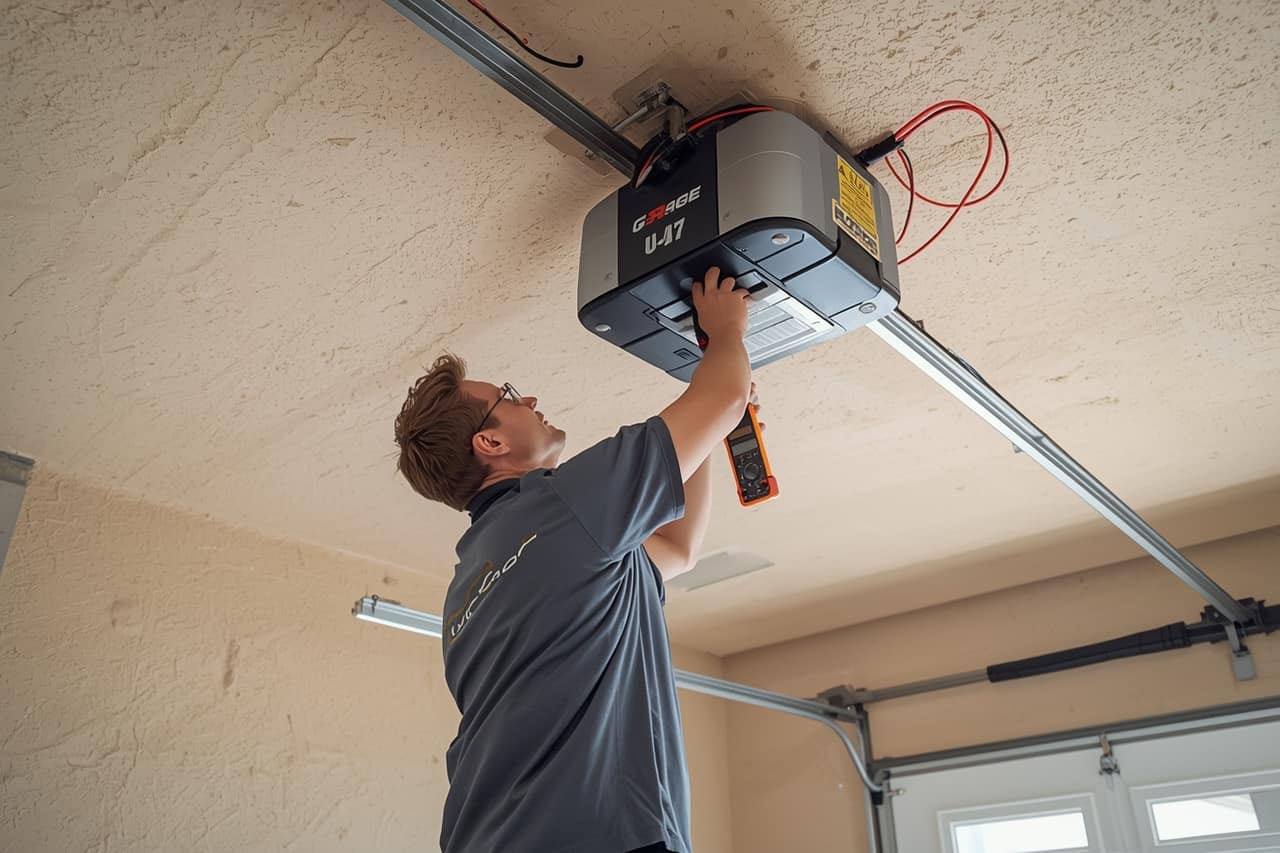
Bosque Garage Door connects homeowners across the Albuquerque, New Mexico metro with a local garage door company for garage door opener repair in Albuquerque and nearby towns. Call (505) 448-3665 and describe what the opener is doing. The call goes to an independent local garage door company, and a price is something to ask for after a technician has looked at the unit.
Openers fail in a handful of repeatable ways, and many of them are inexpensive to fix or are not the opener's fault at all. A dead remote, a misaligned sensor, a spring that has broken and left the door too heavy to lift: all of them look like "the opener is broken." This page is organized around what you actually see and hear, so you can narrow down the cause before anyone arrives, run the checks that are safe, and have a clearer conversation when you call.
What is the opener doing?
Start with the symptom. Each of these has a short list of likely causes.
Nothing at all. No light, no sound, no response from the wall button. The opener has no power or has a failed control board. Check the outlet, a tripped breaker and the cord first.
Remote does nothing, but the wall button works. The remote battery is flat, the remote lost its programming, or the receiver in the opener needs attention.
Wall button and remote both do nothing, but the light comes on. The logic board may have failed, a wall button wire may be damaged, or the opener may be in a locked or vacation mode if your model has one.
Motor hums or runs, but the door does not move or barely moves. This is often a broken spring or a stripped drive gear. A spring failure is far more common, and it is covered on the spring repair page.
The door starts down and then reverses. The safety sensors, a limit setting or the down force is the usual cause.
The door goes up but will not close, and the opener light blinks. The safety sensors are not seeing each other. Blinking lights are the opener's way of reporting a problem.
The door opens or closes partway and stops. A limit setting has drifted, something is binding in the track, or the travel needs adjustment.
Loud grinding, scraping or banging while the door moves. Rollers, hinges or the drive system are worn. The cable, roller and panel repair page covers the door-side causes.
The door moves on its own, or the opener triggers by itself. Often a stuck wall button, a failing remote, or radio interference. It is worth taking seriously, because a door that moves by itself is a safety issue.
Five checks that cost nothing
Before you call anyone, spend ten minutes on these. They resolve a surprising number of service calls.
- Power. Confirm the opener is plugged in and the outlet works. Plug a lamp into the same outlet. Check the breaker panel for a tripped breaker, and if the outlet is a GFCI type, press the reset button.
- Remote battery. Replace the battery in the remote and try again. A remote that works close up and not from the driveway usually has a weak battery.
- Wall button. Press and hold the wall button for a few seconds. Many openers have a lock feature that turns off the remotes. If the light blinks or the remotes are ignored, a lock mode may be on.
- Disconnect and reconnect. Pull the red emergency release cord and move the door by hand if it is fully closed and moves easily. A door that is heavy, jerks or sticks has a door problem, not an opener problem. If so, stop, leave the door alone and read the next list.
- Sensors. Look at the two small eyes near the floor on either side of the door. Both should show a steady light. Wipe the lenses with a dry cloth and look for anything in the path, such as a hanging bag or a mop handle.
Do not do any of the following. Do not reach into the opener housing while it is plugged in. Do not adjust the springs or the bottom brackets. Do not bypass the safety sensors by disabling them or covering them. And do not pull the release cord with the door open or partway open, because a door that is not balanced can fall.
Remotes, keypads and the learn button
Most openers sold in the past few decades has a learn button on the motor head. The button often has a color, and the color tells you which generation of radio system you have. LiftMaster and Chamberlain share the same family of systems, and a remote must match the generation of the opener. A remote from a newer opener will not pair with an older one.
The usual steps to reprogram a remote follow a pattern. Press the learn button once, wait for the indicator light to come on, then press the button on the remote within thirty seconds or so. The opener light blinks or the unit clicks to confirm the pairing. Your model's manual has the exact steps, and the manual is usually available online by model number.
A few cautions help.
- Holding the learn button for a long time often erases every paired remote and keypad. Do it only if you mean to start over, and re-pair everything afterward.
- A keypad takes its own programming. Wireless keypads also take batteries, and many go dead without warning.
- If you lose a remote, or a vehicle with a built-in transmitter was sold or traded, consider clearing the opener's memory and re-pairing the remotes you still have. An unknown remote that is still paired can still open your door.
- Car-integrated systems, such as those built into a vehicle's mirror or visor, often need a separate step that uses the opener's learn button. The vehicle manual explains it.
When the remote and keypad both fail, and the wall button still works, the receiver is probably the weak point. That is a repair for a technician.
Safety sensors and a door that will not close
Every opener made since 1993 has to carry a safety system that reverses the door if something breaks the beam of the photo eyes or if the door meets resistance on the way down. The eyes are the small units near the floor on each side. One sends an invisible beam, the other receives it. If the beam is blocked or the eyes are misaligned, the opener will not close the door by remote and may flash its light.
Common sensor problems, in the order worth checking:
- Dirt or a cobweb on a lens. A dry cloth clears it.
- Knocked out of line. A bump from a bike or a hose can swing an eye a few degrees. Each eye has a small light that should glow steadily when aligned. Loosen the bracket, adjust it until both lights are steady, and tighten.
- Low sun at the wrong angle. Strong direct sunlight shining into one eye can confuse it at certain times of day. Shading the eye with a short tube or moving it often fixes the problem, and the trouble may only show up at sunrise or sunset.
- A damaged or loose wire. The thin wires that run from the eyes to the motor head can get nicked by staples, tools or a stray hit from a car. A technician can test them.
- A failed eye. If an eye shows no light after wiring and alignment checks, the unit itself may need replacement.
If your door closes with the wall button held down but not by remote, that is often a sign the sensors are the problem. It is a temporary workaround, not a fix. Do not rely on it.
Limits and force settings
The opener has two limit settings that tell it where the door stops at the top and the bottom, and a separate setting for how hard it pushes. They are adjusted with screws or buttons on the motor head, depending on the model.
If the door stops short of closing, reverses off the floor, or bangs hard at the top, the limits have drifted or were set badly. On a stiff door, the opener may stop partway because it is sensing resistance. Increasing force to fix that is the wrong move. Turning the force up can hide a binding track or a worn roller, and it can defeat the safety reversal.
A properly adjusted door stops gently at the floor, reverses when it meets a board or a hand, and does not slam open. A technician tests this by placing an object under the door and watching the reaction.
Motor, gear and board failures
Some opener problems are internal. These are the ones that tend to need a repair visit.
Stripped drive gear. Many openers use a plastic or nylon gear to carry force from the motor to the drive system. It wears out. The symptom is a motor that runs and a trolley that does not move, or a ratcheting noise. Replacement gear kits exist for many models, and the repair is often worth it on a good opener.
Circuit board. Lightning, power surges, age and heat can damage the logic board. The signs include a unit that clicks, a light that comes on and shuts off, or a unit that works only sometimes. Board replacement costs more than a gear and gets harder to justify on an older opener.
Motor capacitor and motor. A hum with no movement can be a failed capacitor. A burned smell or a motor that runs hot points to a failing motor.
Drive system. Chain openers can stretch and sag. Belt openers can fray or slip. Screw drives can bind. A sagging chain or noisy trolley is usually an adjustment or a part.
Wiring and wall buttons. Wires to the wall control run along the ceiling and can break or short. A technician can test the circuit.
Opener or door? Telling the difference
A lot of calls for opener repair turn out to be door problems. Disconnect the opener with the release cord, with the door closed, and lift the door a few inches by hand. A balanced door lifts easily and stays where you leave it at about waist height. A door that feels heavy or drops is out of balance, which means a spring or cable problem. The opener is not the cause, and replacing it will not help. If you can't do this check safely, skip it and describe the symptoms to the company.
If a technician finds the door out of balance, fixing the spring before the opener spares the opener from working against a heavy door. It is common to fix both in one visit.
Wind, dust and temperature swings
Albuquerque weather reaches the opener in a few specific ways.
Dust on the eyes and rail. Spring is the windiest season in the metro according to the National Weather Service, and blowing dust is part of it. Dust settles on the safety sensor lenses, collects on the rail, and mixes with old grease on the trolley. A dusty lens can make the eyes unreliable long before they stop working. Wiping the lenses with a dry cloth at the start of spring wind season is a small habit that prevents a number of false reversals. Wipe the rail too, and do not drench it in oil, because a heavy coat holds more grit.
Low sun on the sensors. The sun is strong at this elevation, and a door that faces east or west can have direct light entering a sensor lens at sunrise or sunset. If your door misbehaves only at a certain time of day, suspect the eyes. Shading the receiving eye with a short tube is a common fix, and the technician can reposition the pair.
Big temperature swings. The Albuquerque Sunport averages about a 25 degree daily range, with a January average low near 26 degrees. A cold garage thickens grease, stiffens the drive and raises the strain on the motor, and a unit with a weak capacitor or tired gear may fail on a cold morning. If an opener only struggles in winter, that is a hint to have the drive and the door balance checked, not a reason to raise the force setting.
Monsoon storms. The National Weather Service counts monsoon season as June 15 through September 30, and summer storms bring gusts and lightning. If an opener board fails after a storm, power surges are one possible cause. Plugging the unit into a surge protector, or having a technician advise on one, is a sensible precaution.
Wind also pushes on the door itself. A door that is a little out of alignment can rattle and bind in a gust, and that makes the opener work harder. The high desert wind and dust guide covers this.
Repair it or replace it
Not every opener is worth saving. A few rules of thumb help.
- Age. Openers do not have a fixed life, but many serve for ten to fifteen years or more. An older unit with several repairs behind it is a poor bet.
- Safety features. Openers from before 1993 lack the photo-eye reversal system. If yours has no sensors, replace it.
- Parts. If the model is no longer supported and the board or gear is not available, repair is a gamble.
- Cost. If the quote for a repair approaches half the cost of a new unit, compare the two.
- Features. Newer openers offer quieter belt drives, battery backup, built-in lighting, app control and keypads. If you want those features, a failing opener is a natural time to change.
- Matching. A new opener also needs the right rail and hardware for the door. The opener installation page explains what a replacement involves.
What a repair visit involves
A typical opener repair follows an order that keeps the visit short.
- The technician asks what the opener is doing, then tests it.
- They check power, the wall control, the remote and the sensors.
- They test the door balance by hand with the opener disconnected.
- They check the limits and force, and look at the drive, the gear and the rail.
- They explain what they found and what the options are, with the price, before starting a larger repair.
- After the repair, they test the safety reversal with an object in the path of the door and confirm the remotes and keypads work.
If you have a few spare remotes, keep them handy for the visit so the technician can test and reprogram them.
What moves the price
Costs depend on the opener, the failure and who does the work, so these are general national ranges, not Albuquerque prices. A national cost guide published in 2026 puts typical opener repair at about $100 to $400, with an average near $174. A sensor realignment or a remote reprogramming sits at the low end. A board, motor or drive replacement sits at the high end and can approach the price of a new unit. A local company gives the real price after looking at the opener.
What changes the number:
- What failed. Sensors and remotes are inexpensive parts. Boards and motors are not.
- Brand and age. Parts for current LiftMaster, Chamberlain and Genie models are easy to find. Parts for discontinued models may not exist.
- Drive type. Belt, chain and screw drives have different parts and different failure patterns.
- Door balance. If the real problem is a spring or cable, the repair is on the door, not the opener, and its price follows the door repair.
- Hours. Calls outside normal hours often cost more.
Ask for the quote with the part and labor separated, and ask what a replacement would cost for comparison.
Questions to ask before you approve a repair
- What exactly failed, and can you show me the part?
- Is the repair a part swap or an adjustment?
- If the opener is replaced, what model and drive type is proposed?
- Are the safety sensors, springs and door balance part of the check, or only the opener?
- Is anything about the parts or labor covered in writing, and for how long?
- Will you reprogram all my remotes and keypads before leaving?
It is reasonable to ask about the contractor's license, too. In New Mexico, contractor licensing is handled by the Construction Industries Division. The state's rules do not list garage doors as their own classification, and the closest named one is GS-14, windows, doors and skylights, with GS-29 as a miscellaneous classification for work that fits no list. Ask the company which classification applies, then look up the license on the state verification page before the visit.
Where this service is available
The local company reached through (505) 448-3665 serves the metro, including Albuquerque, Rio Rancho, Corrales, Bernalillo and Los Lunas. When you call, give the opener brand and the color of the learn button if you can see them, and describe the symptom in your own words. If the door is stuck open or closed and you need it to move, say so. The emergency garage door repair page covers urgent situations, and the repair cost guide explains how quotes are built.