
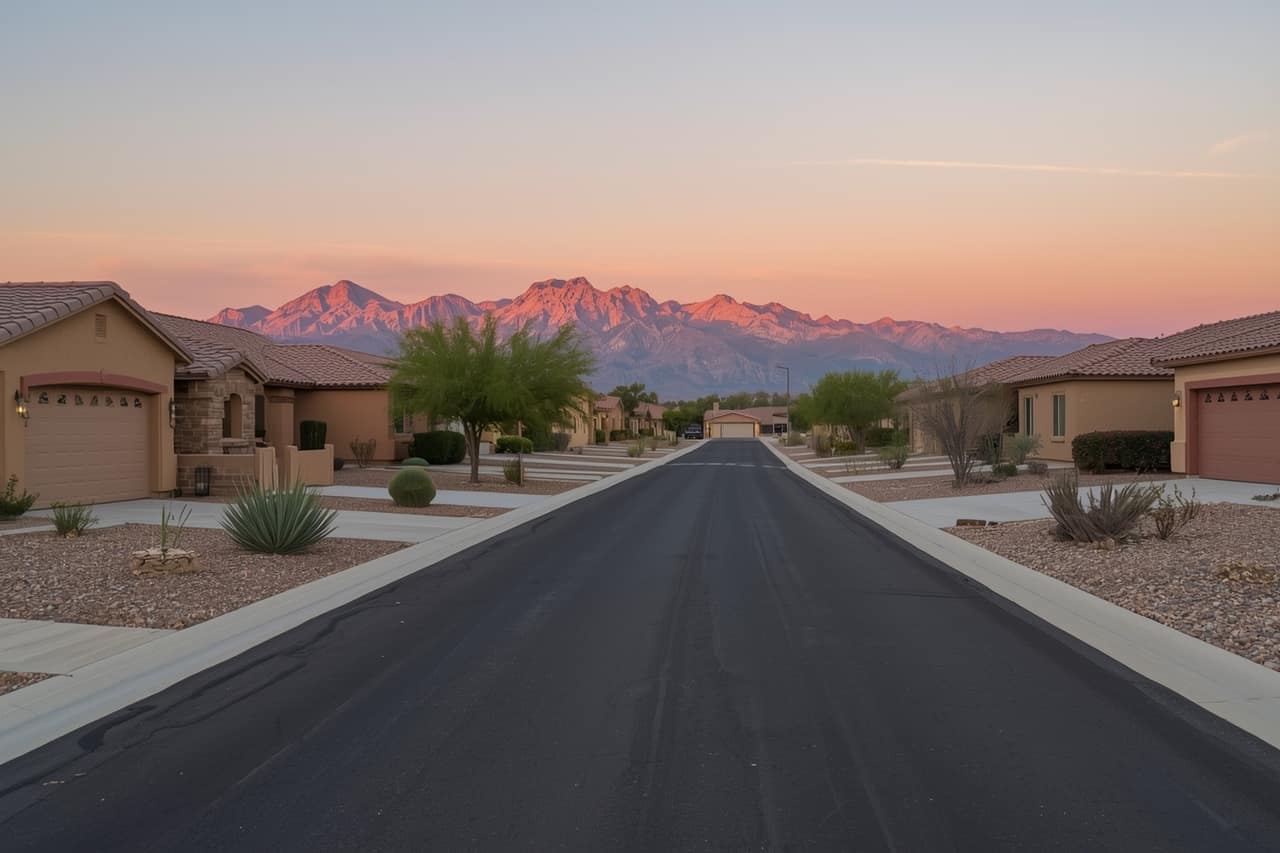
Bosque Garage Door is a referral site, and this page is about the city of Albuquerque itself, its neighborhoods, rather than the whole metro. If you are looking for the wider region, the home page covers that. Here the focus is the streets inside city limits, where Bernalillo County's biggest population sits and where homes range from decades-old neighborhoods to newer master-planned areas.
The U.S. Census Bureau's July 1, 2025 estimate puts Albuquerque at 556,588 residents. The 2020 to 2024 American Community Survey counts 258,178 housing units, with a median year built of 1982. About 47 percent of those units were built before 1980, and about 25 percent in 2000 or later. That split is the most useful fact on the page. Roughly half the city has garage doors that are more than forty years old or that have been replaced at least once, and a quarter of it has doors from the last twenty-five years. The two groups break in different ways.
Start with the year the house was built
A 1960s or 1970s house in the Northeast Heights, Nob Hill or the South Valley often still has the layout it was built with: a single garage or a modest double, a one-piece or sectional door, and sometimes an original or early replacement opener. Older doors in that range are frequently balanced by extension springs, the long springs that run along the horizontal tracks on each side. They cost less to make but they stretch, they fail in pairs, and when one lets go it can whip around the garage. Many carry a safety cable through the center of the spring for that reason, and a door without that cable deserves a closer look.
Newer houses, particularly those on the Westside and in the master-planned areas, tend to have a torsion spring mounted on a bar above the door. Torsion springs wear by cycle count rather than by age, so a busy household with a two-car garage and daily commuting can use one up in about the same number of years as a quiet household uses a pair of extension springs. The spring repair page explains how to tell which kind you have and what a replacement involves.
Openers follow the same timeline. A unit from the 1980s or early 1990s may lack photo-eye sensors, which are the beams near the floor that reverse the door when something crosses them. It may also lack battery backup, so a power outage leaves the door stuck down. Anyone with an opener that old has two reasonable paths: have a local company repair it, or look at opener installation for a unit with current safety features. The opener repair page covers what is worth fixing and what is not.
The Northeast Heights and Sandia Heights
The Northeast Heights climb toward the Sandia Mountains, and the city's centroid elevation of about 4,963 feet understates how high the upper neighborhoods sit. Areas named for this part of town include High Desert, Tanoan, Sandia Heights and North Albuquerque Acres. The Heights are known for mid-century modern homes, and Sandia Heights for a High Desert contemporary look.
What matters for the door is exposure. A garage face that points south or west takes sun for much of the day, and a door on open ground is more exposed to gusts than one sheltered by buildings and mature trees. The warning of March 18, 2025 that covered Bernalillo County listed Sandia Heights alongside the rest of the metro, so this is not a quiet corner. Sun and wind do their damage to weatherstripping, paint and the bottom seal first, and then to the door's alignment if a gust catches a section that is already loose.
If your Heights development has an association with design rules, read your covenants before you change the style or color of a door. A repair that keeps the same panels is rarely the issue, but a replacement door can be.
Nob Hill, Old Town and the city's older core
Nob Hill and Old Town hold some of the city's most familiar Pueblo Revival houses, with stucco over adobe or masonry and heavy wood details, and Downtown and the area around it include Territorial style. The garages here are often smaller than a modern two-car bay, and some are detached, set at the back of a lot and reached by an alley or a long drive. A detached garage can still have a standard opener, but a long run of wiring, an old outlet or no outlet at all changes what an installation involves.
The older core is also where historic character matters most to the owner. A flat-panel steel door in a color that suits the stucco is a very different thing from a carriage-style door with decorative windows, and the right choice depends on the house. A local company can tell you what fits the opening. If the opening is an unusual size, as many pre-war and mid-century garage openings are, a standard stock door may not fit and a custom size takes longer to arrive. The garage door installation page walks through measuring and choosing.
The North Valley, South Valley and the river corridor
Along the Rio Grande the housing changes again. The North Valley and South Valley sit near the river and its ditches, and the NWS dust warning named both areas by name. If your garage is detached or older, or a shop door sits well away from the house, an opener at that distance may need a separate power source, so mention it when you call.
Irrigation ditches run through the river valley, and the soil along them stays damper than higher, drier ground. Moisture at the slab edge, standing water after a storm or a ditch overflow can rust bottom brackets and the lower sections of a steel door sooner than elsewhere. If the bottom panel of a door has swelled or the lower hinge has rusted through, that is usually an aging or moisture problem rather than a mechanical one, and whether one panel will do is a question for the technician.
The Westside: Paradise Hills, Taylor Ranch and newer subdivisions
Paradise Hills and Taylor Ranch are Westside neighborhoods, and Paradise Hills is named in the NWS dust warning. Newer master-planned parts of the city often have associations: Ventana Ranch Community Association has a public listing. The city's own page on neighborhood associations says it does not cover HOAs, so the covenants are the document to read.
A house built after 2000 is the group most likely to have a torsion spring, a belt or chain drive opener and a door in a builder-grade color. Association rules in these areas often cover exterior color, door style and sometimes visible hardware. Typically a repair that replaces a spring, cable or roller changes nothing visible and is treated as maintenance. A new door is a design change, so ask the association before ordering one.
Wind, dust and the monsoon
Spring is the windiest season in Albuquerque. The National Weather Service says the spring maximum shows up at every monitored site, and that high wind events often have a westerly component. A High Wind Warning is issued for sustained winds of 40 mph or gusts of 58 mph or more, and April and May are the peak months. On March 18, 2025 a Dust Storm Warning covered the metro with visibility under a quarter mile.
A door facing west takes those gusts squarely. The practical effects are grit in the tracks and on the rollers, a bent or loosened panel if the door was open when a gust hit, and a bottom seal that lifts or tears. After a windy week it is worth running the door by hand with the opener disconnected to see whether it moves freely. The longer discussion is in the high desert wind and dust guide.
The monsoon runs June 15 to September 30. The Albuquerque area averages 4.47 inches of monsoon rain, and July is the wettest month at the Sunport with a 1.64 inch normal. Storm outflow can bring a short blast of wind and small hail, and rain on a door with a damaged seal means water on the garage floor. Add summer heat, a July average high of 91.2 degrees against a January average low of 26.4, and every spring and cable goes through a wide temperature swing that the annual mean daily range of 24.8 degrees at the Sunport only hints at.
Permits and checking a contractor
The City of Albuquerque's Express Permitting page lists small repairs and minor alterations, such as window or door replacements, as an express permit type. It does not name garage doors. The city's homeowner guide says some small projects need only a Minor Alteration and Repair permit and that plan review can be reached at 505-924-3320, option 2. Whether a garage door replacement needs a permit is not stated, so a quick call to plan review answers it before work starts. The city permit guide is the place to start.
The state has no contractor category named for garage doors. The nearest is GS-14 (windows, doors and skylights), and the Construction Industries Division can place unlisted work in a miscellaneous GS-29 class. A business that advertises repair work generally needs a CID license, so asking for the license number and checking it in the CID license lookup is a reasonable step before you agree to a job.
What it costs, and who does the work
Bosque Garage Door is a referral site, so the price comes from the local company that looks at your door, not from this page. For context only, general national ranges from published guides put a torsion spring replacement at roughly $150 to $450 and a standard opener installation at $250 to $600, and a technician who sees the door can give the real number. The Albuquerque garage door repair cost guide explains what moves a price up or down.
When a door is stuck now, call (505) 448-3665 and say which part of the city you are in. The general cable and roller repair page covers the basics. If your house is closer to a suburb than to the city proper, Rio Rancho and Corrales have their own notes, and Los Ranchos borders the North Valley.